



Important lab findings pass peer review. Report: Claire Robinson and Jonathan Matthews
A new publication marks the entry into the peer-reviewed literature of some remarkable lab findings on synbio milk. Synbio is short for synthetic biology, an extreme form of GM. The synbio fake milk that was analysed in the lab tests was produced from genetically engineered yeast in a process known as “precision fermentation”. The testing showed that contrary to the manufacturer’s claims, the synbio milk is nothing like cow’s milk and the production process is anything but precise.
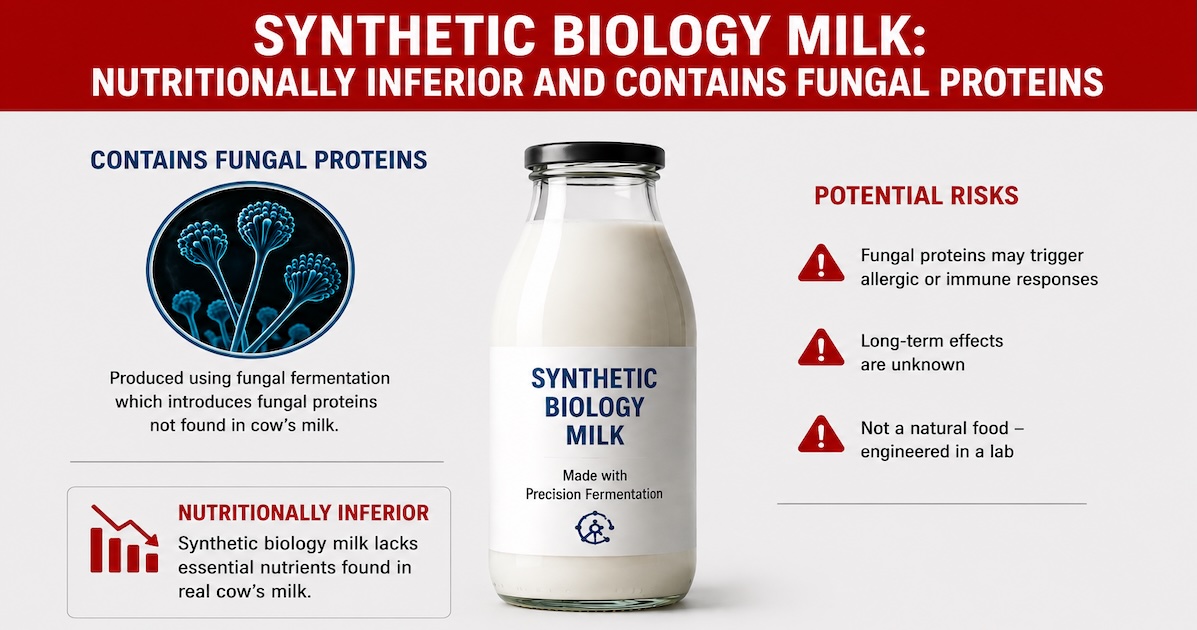
In the study, published in Scientific Reports, multi-omics profiling (in-depth molecular analysis) found that synbio milk differs nutritionally from cow’s milk and contains 93 uncharacterised fungal metabolites and 236 fungal proteins.
The authors, based at Health Research Institute (HRI) in the US, write: “By three independent methods synbio milk was found to contain predominantly fungal protein, not the 90–99% β-LG [recombinant bovine β-lactoglobulin], claimed by the product developer." Bovine β-lactoglobulin is the most abundant whey protein in cow’s milk.
In addition, the scientists found that the synbio milk was nutritionally deficient: there were “substantial levels of 69 nutrients in bovine milk, of which only 7 were present in small amounts in synbio milk”.
Their analysis also revealed “93 compounds in synbio milk, byproducts/waste products of fungal fermentation, whose chemical identities could not be established searching large mass spectral databases, suggesting they are novel compounds. Neither these nor the fungal proteins found in the synbio milk have been tested for safety or allergenicity at exposure levels relevant for synbio milk consumption. Therefore, comprehensive toxicity and allergenicity testing are needed to assess the safety of synbio milk for human consumption.”
The companies
The brand name and manufacturer of the synbio milk product in question are not mentioned in the published article. However, it appears to be the same product as that featured in media reports about the lab findings back in 2024 and 2025. In these reports, the product was named as Bored Cow, a brand of Tomorrow Farms. The manufacturer of the GM yeast-derived protein, known as ProFerm, was given as the biotech startup Perfect Day.
Dr John Fagan, chief science officer at HRI and corresponding author on the new publication, was reported at the time as saying that there were 92 small molecules in the product that are unknown to science: “They’re completely novel to our food. They are things that we haven’t consumed as human beings.” This was in spite of reported claims by Perfect Day and Bored Cow that the synbio protein is identical to the protein in cow’s milk.
While the lab findings themselves are not new, the current development is that they have been assessed as scientifically and methodologically sound, having passed peer review and been published in the scientific literature.
Lawsuit
Perfect Day was hit in 2025 with a lawsuit alleging it is misleading consumers about ProFerm. In the lawsuit, filed in the District of Columbia, plaintiffs the Organic Consumers Association and GMO/Toxin Free USA argue that “Perfect Day markets ProFerm as safe, environmentally friendly, identical to cow-derived whey protein, capable of creating milk identical to cow’s milk – including its nutritional profile – and free from genetically modified organisms. The reality is markedly different.”
As part of their legal action, GMO/Toxin Free USA and the Organic Consumers Association commissioned HRI to analyse the synbio product. The results appear to be those that were recently published in Scientific Reports.
It is astonishing that any claim could be made that the synbio milk was “identical to cow’s milk” when the product in question only contains a single whey protein (β-LG) and so lacks the several other casein and whey proteins that are normally present in cow’s milk. It is all the more astonishing that the lobby group WePlanet, with the endorsement of George Monbiot, among others, is encouraging EU and British governments to pour vast sums of public money into “precision fermentation” as a solution to the climate and biodiversity crises, on the basis that this technology can produce “proteins that are biologically identical to those found in animal products”. In other words, it’s not just a company making the biologically identical claim to help sell its “milk” product, but a whole lobby claiming that this is the future of food, and, in George Monbiot’s words, “the beginning of the end of most agriculture”.
Synbio milk brand vanishes
What do the findings mean for the future of the synbio milk? Bored Cow’s website is no longer functioning and the product seems to have quietly disappeared from shelves, although what may be surplus stock is currently still available to order online via a few outlets, like Walmart. Another product made with Perfect Day’s ProFerm – an animal-free “ice cream” known as Brave Robot – has also been discontinued.
Perfect Day still seems to exist, although it has downsized its workforce and shuttered its consumer-facing brands. At the end of 2025, the company said it expected manufacturing operations to begin at its new production facility in Gujarat, India, in the second half of 2026. Its business plan appears to consist of selling its genetically engineered yeast products as ingredients for inclusion in other brands. In the past, these have included the food giants Mars and Nestlé, though the resulting products never hit the mainstream and proved short-lived.
Synbio milk findings raise questions about other GM-derived foods
HRI’s findings build on safety questions about other foods derived from GM micro-organisms, such as Impossible Foods’ soy leghemoglobin, which is added to fake meat burgers in the US to give a ‘bleeding’ appearance, like undercooked meat.
A particular concern regarding the food safety of the soy leghemoglobin product (called LegH Prep) is that it is only 65% soy leghemoglobin. The other 35% is made up of contaminant proteins and (potentially) metabolites derived from the GM yeast production strain. This high level of contaminants – effectively the ‘dark matter’ of LegH Prep – includes an unknown number of proteins that remain unidentified and unanalysed for safety, as revealed by the company’s submission to EFSA for EU food approval. Nevertheless, EFSA gave a favourable opinion on the safety of the product for food use, though the EU institutions and Member States have not yet approved it for commercialisation.
The soy leghemoglobin product has been used in the Impossible Burger in the USA for several years. That doesn’t prove it’s safe, as there is no widely understood and popularly used procedure for systematically tracking any reactions that consumers may have to the product.
Highly likely synbio products will contain contaminants
The 35% contaminants in LegH Prep are especially concerning in light of a tragic episode in the 1980s, in which over 1500 people were sickened and some died after consuming a GM bacteria-produced version of the food supplement L-tryptophan. The toxicity turned out to be due to unexpected contaminants resulting from unpredictably disturbed biochemistry of the GM bacteria. Even though the L-tryptophan purification process used by the manufacturer was of a high standard, the company was unaware of these contaminating toxins. Therefore, the purification process proved to be inadequate.
Commenting, Prof Michael Antoniou said: “The synbio milk and LegH Prep molecular composition profile findings, as well as the L-tryptophan episode, show that with current technologies it is difficult, if not impossible, to purify GM micro-organism-produced proteins or small biochemicals intended for food use to an extent that the final product only consists of what the manufacturer intends. It’s therefore highly likely that such products will contain contaminants, which could prove to be toxic or allergenic. These examples should teach manufacturers and regulators alike that rigorous multi-omics (molecular analyses) must be performed on these products to look for potential toxins and allergens as a foundation for follow-up animal toxicity studies before they are released into the food supply.”
Meanwhile consumers should be wary of any synbio or GM food ingredient that lacks a history of safe use in food. For the same reason, Dr John Fagan previously recommended that the synbio milk product his team studied should either carry a risk warning on its packaging or be taken off the market altogether.
The new publication: Velamuri R et al (2026). Multi-omics profiling finds synbio milk differs nutritionally from bovine milk and contains 93 uncharacterized fungal metabolites and 236 fungal proteins. Scientific Reports volume 16, Article number: 16029 (2026). https://www.nature.com/articles/s41598-026-38994-7