








Experts challenge SilvaBio claim that genetically engineered American chestnut tree has been “validated”
SilvaBio, the corporation seeking to mass clone and sell genetically engineered American chestnut trees, released a press release on 25 April claiming “four independent studies” validate the blight tolerance of their Darling 54 trees. In reality, according to the Global Justice Ecology Project (GJEP), “SilvaBio repackages limited, short-term and previously available studies to create the appearance of momentum for a deeply flawed tree.”
GJEP writes: “Two of the cited sources are from SUNY-ESF, the institution that developed Darling 54 (mislabelled D58), is seeking its federal deregulation, and that commercially licensed it to SilvaBio. Other ‘new data’ include 2019 and 2020 studies from Purdue, a 2025 study from the University of New England, and SUNY-ESF’s 2023 ‘Science Update’ as its sources.”
GJEP adds: “Far from validating the ‘blight resistance’ of the D54, what these studies actually show is limited and very short-term: smaller cankers under controlled inoculation conditions in young trees in a 2 year study.
“They do not demonstrate that Darling 54 is fit for long-term survival, reproduction, or restoration in wild forests. ESF’s own 2023 summary acknowledged that Darling 54 trees were shorter than their non-GE siblings and that the trials were in ‘early stages’ and would need years of monitoring.
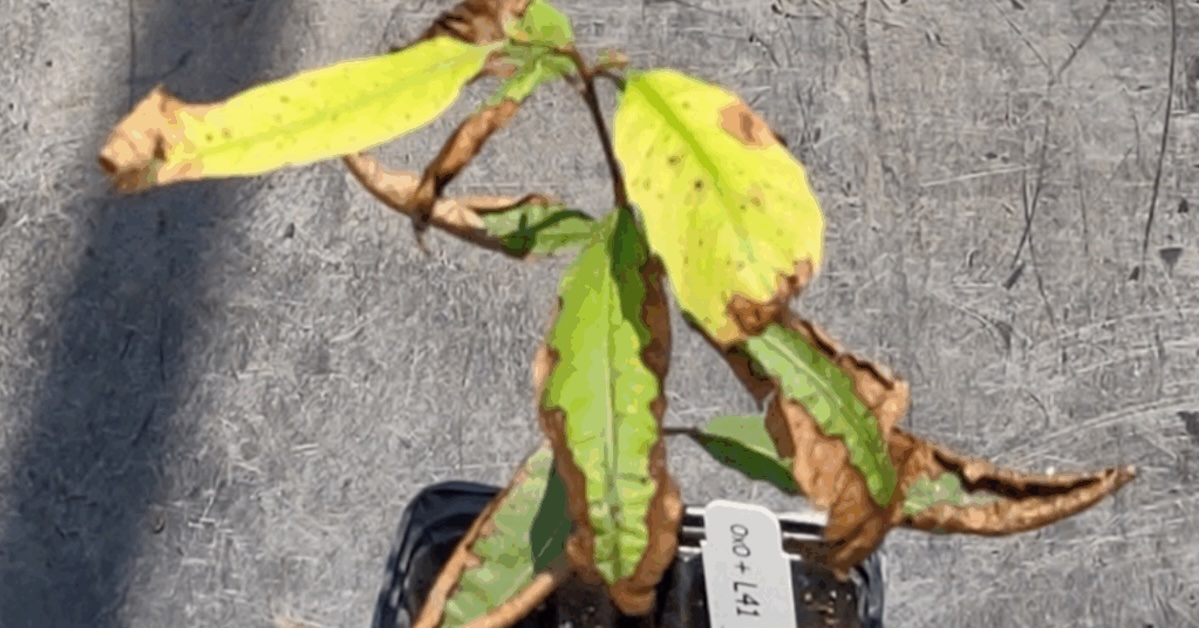
“The American Chestnut Foundation, once a major backer of the D54, withdrew its support after exposing evidence of inconsistent blight resistance, a deleted gene, stunted growth, decreased survival, and a serious mislabelling error. TACF concluded that due to Darling 54’s genetic issues, it should not be propagated beyond permitted sites.”
TACF also challenged ESF’s commercialisation license: “Commercialising the transgenic American chestnut tree is contrary to statements made in regulatory filings and assurances given in public statements and to academic partners. The considerable support TACF provided to help [ESF] negotiate the regulatory process was based upon the understanding that a deregulated tree would be in the public commons.”
Independent scientific analysis underscores these concerns. Geneticist Dr Ricarda Steinbrecher writes in a recent scientific briefing on the Darling line of GE chestnut trees, “The [D54] GE trees do not function as intended or predicted by their developers.”
She notes that “a reliable long term risk assessment for the use of GE forest trees is near impossible.”
“This isn’t a breakthrough — it’s damage control,” said Anne Petermann of Global Justice Ecology Project. “After the very public failure of Darling 58 — which turned out to be a mislabelled Darling 54 — old problems are being repackaged as progress. A deleted gene, human error, and inconsistent performance have already raised serious concerns.
“Using two-year field trials to justify releasing a genetically engineered tree into wild forests is not science — it’s marketing,” she added.
GJEP writes: “Smaller cankers in young, controlled trials are not the same as proven forest restoration. Once genetically engineered trees are released, they cannot be recalled. The American chestnut is known to live for hundreds of years. Its pollen, seeds, and genetic traits could spread for generations. It is for these reasons that 170,000 people publicly rejected this defective GE tree during the USDA’s last public comment period for the Darling 54.
“Darling 54 must not be deregulated, commercialised, or released into wild forests.
"We reject the release of genetically engineered trees into wild ecosystems and call for precaution, transparency, and support for non-GE forest restoration.”
Global Justice Ecology Project works across the US and internationally to advance forest protection, climate justice and human rights. They coordinate the Campaign to STOP GE Trees.
Notes
Genetically engineered American chestnut: Discussion of the performance limitations of Darling 58/54, Econexus
The American Chestnut Foundation, “Darling 58/54 FAQ”
Center for Food Safety scientific review of the Darling 58/54 as submitted to the USDA (2023)
The Darling 58 debacle, Earth Island Journal
Press release: 170,000+ demand USDA reject proposal for release of genetically engineered American chestnut into wild forests (July 2025)
Holiday revelation: Wild American chestnuts thriving on biologist’s land in Maine, GMWatch (2025)
Biotechnology for forest health? The test case of the genetically engineered American chestnut (2019)
See a list of organisational and scientific comments submitted to the USDA regarding the petition to deregulate the Darling 58/54 GE American chestnut tree (January 2023)
SilvaBio press release (25 April 2026)
Image: Blight symptoms on engineered seedling. Copyright: TACF