


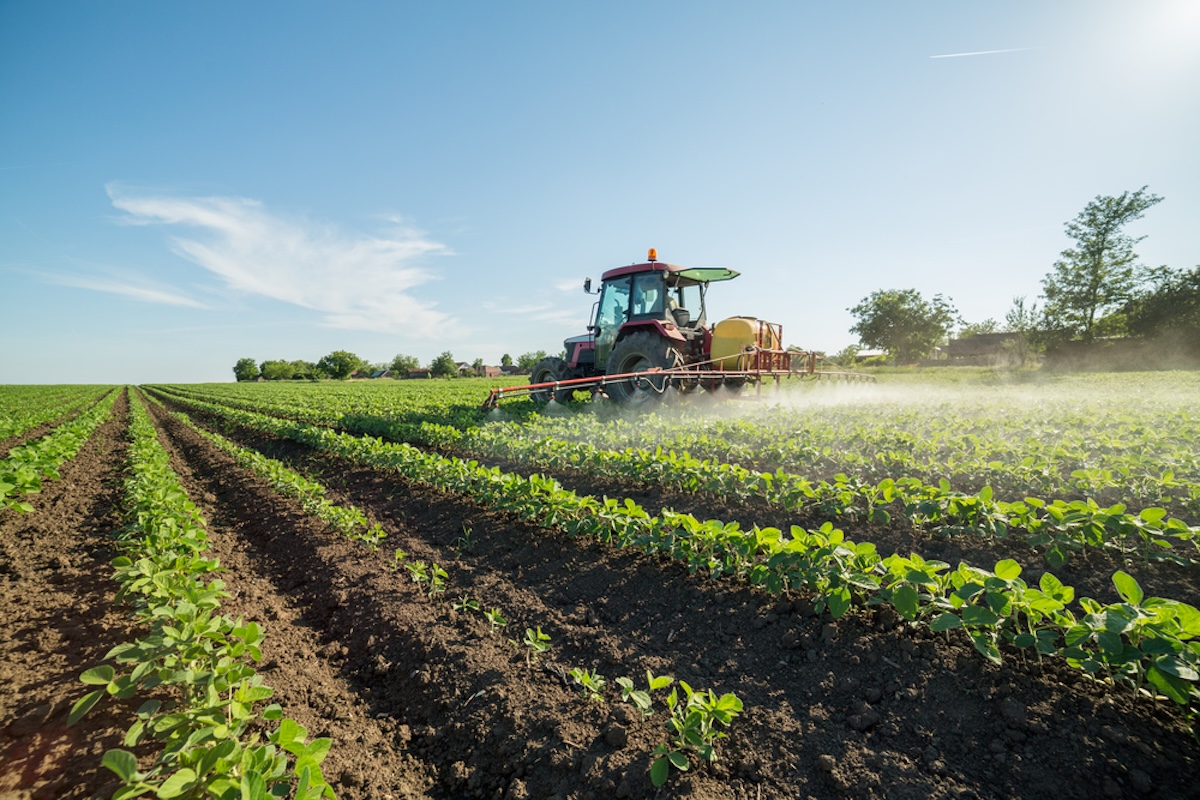
Dario Aranda reports on “a massive open-air experiment”
The arrival of GM soy marked a turning point in Argentina’s agricultural model and served as a beachhead for GM crops in South America, writes Argentine journalist Dario Aranda in an article for Tierra Viva news agency.
Dario recounts: “In a fast-track process, aligned with the United States and Monsanto, Carlos Menem’s government approved the GM soy seed, which would soon become a monoculture.” Over three decades of the GM model, he writes, thousands of families have been evicted from their lands, millions of hectares of land have been ravaged, and epidemics of diseases caused by agrochemicals have burgeoned. But resistance and the determination to sow the seeds of a different model of agriculture continue to grow.
There follows a Deepl translation of Dario’s article into English, slightly edited for clarity.
___
Billions of dollars. This is the aspect highlighted by the proponents of the agribusiness model, with genetically modified soy as its flagship. On the other side of the scale: disease epidemics in areas sprayed with agrochemicals, land concentration in the hands of a few, the disappearance of 83,000 small and medium-sized farms, the displacement of thousands of rural families, eight million hectares of native forest razed, and the contamination of water, air and soil. And, despite everything, the collective decision to organise, demand justice, sow life and, ultimately, build territories of dignity.
State policy
It was 25 March 1996. At 982 Paseo Colón Street, at the Ministry of Agriculture, the then Minister Felipe Solá signed the authorisation for the commercialisation and sowing of Monsanto’s genetically modified soy seeds. It was a done deal, based on ‘studies’ by the US company itself and carried out in a rush: 81 days for a green light that would affect millions of hectares and lives. It was the first genetically modified organism approved in the Southern Cone (it would later enter Brazil, Uruguay, Paraguay and Bolivia illegally).
Every [Argentine] government, from Carlos Menem to the present day, has championed this same model (agribusiness), which is centred on soy and the use of agrochemicals. The best-known of these poisons, though not the only one, is glyphosate.
The area under soy cultivation rose from six million hectares in 1996 to the current 18 million, peaking at 21 million hectares in 2015. The use of agrochemicals skyrocketed: 500 million litres, an average of 12 litres per person per year. Exports multiplied, 4x4s proliferated across the Humid Pampas, dollars to ‘sustain’ the dependent economy poured in, farmers’ investment in ‘bricks’ grew, and GM monoculture took hold.
The biggest winners:
• The major seed and agrochemical companies: Bayer/Monsanto, Syngenta-ChemChina, Corteva (Dow/DuPont) and BASF.
• The agro-export corporations: Cofco, Cargill, Bunge, Dreyfus, Viterra and AGD.
• Their local allies: the self-styled “agricultural bodies” (Aapresid, Sociedad Rural, CRA, Coninagro, Federación Agraria), the mainstream media and compliant journalists, hegemonic and extractive science, and the government of the day (municipal, provincial and national).
A turning point came in 2008, with the now historic Resolution 125 [a government proposal to raise taxes on agricultural exports (principally soybeans) to increase state funds, reduce domestic food prices, and encourage domestic food production, which triggered protests by farming associations and was finally defeated in the Senate]. As never before, “the countryside” became a topic on the national agenda and in public debate. Suddenly, city dwellers who owned nothing more than potted plants came out in defence of millionaire businessmen with thousands of hectares in the country’s most expensive areas.
The agribusiness sector emerged victorious from a dispute in which the main point of contention was who would get a larger slice of the pie, who would capture more ‘rents’. None of the sectors involved challenged the core issue: the agricultural model.
A model with far-reaching consequences
Between 2002 and 2018, 83,000 smallholdings were lost. That is a way of saying that the larger farms swallowed up (or drove out) the smaller ones. The country’s agricultural structure has changed. The ‘green desert’ and the depopulation of the countryside advanced just as rapidly as speculation by planting pools [speculative, large-scale investment funds in agriculture that unite investors to finance crop production] and producers who prioritised only the dollars from Europe and Asia. Argentina harvested less and less food for the local market, and produced more and more commodities for the pigs and poultry of Asia and Europe.
Agricultural capitalism showed its true colours and its ruthless ways:
• Thousands of peasant and indigenous families have been evicted from their ancestral lands.
• Eight million hectares of native forest have been razed, placing Argentina among the top five countries for deforestation.
• Legal proceedings, repression and murders in rural areas. Among the most extreme cases (though by no means the only ones): the murders of Sandra Ely Juárez, Cristian Ferreyra and Miguel Galván.
• Pollution. Contamination of soil, air, water and human bodies with agrochemicals has been confirmed, including among people living in cities. Dystopian situations have become commonplace, such as the presence of more agrochemicals in the Paraná River than in a soy field, or rainwater containing glyphosate – and thus toxins in the atmosphere.
• More than 1,000 scientific studies confirm the consequences of glyphosate (which is just one of dozens of agrochemicals in use).
• The epidemic of diseases linked to agrochemicals is spreading rapidly in areas where pesticides are used extensively. One of the most compelling pieces of evidence is the work of the Institute of Socio-Environmental Health at the University of Medical Sciences of Rosario (UNR). Over a seven-year period, it visited eight towns in Santa Fe and confirmed a cluster of diseases linked to agrochemicals: cancer, miscarriages, kidney disease, birth defects, endocrine disorders and hypothyroidism. The research, published in the international scientific journal Clinical Epidemiology and Global Health, highlights the risk: young people living in sprayed villages are 250 per cent more likely to develop cancer than those who do not live in agribusiness villages.
The cogs of the system
The propaganda machine grew in tandem with the number of hectares sprayed. The newspapers La Nación and Clarín were pioneers, but not the only ones: radio stations, websites, ‘specialist journalists’, television programmes. A whole media apparatus at the service of GM agriculture, funded by… the GM companies.
Hegemonic sectors of “science” were at the service of the model. From the Ministry of Science to Conicet and national universities. Some particularly obscene cases include:
• Minister Lino Barañao claimed that glyphosate was like “salt water”.
• The “renowned” scientist Raquel Chan – funded by Conicet, the University of the Litoral and the company Bioceres – is partly responsible for Argentine families being the first in the world to eat genetically modified wheat, grown using the dangerous herbicide glufosinate ammonium.
• The Faculty of Agronomy of Buenos Aires (Fauba) is openly funded by agribusiness multinationals.
• The National Biotechnology Commission (Conabia), a “scientific-technical” body that approves GMOs, operated in secret for two decades. Its members and reports were confidential. Until the names of those involved in scientific corruption came to light: in Argentina, the very companies that sell GM crops are the same ones that approve them, either through their own employees or through scientists and officials in their pay. More than 90 GM seeds (soy, maize, potato, cotton, alfalfa, wheat) have already been approved, always based on studies carried out by the very multinationals that market them.
Fighting and sowing life
“Apologies for the inconvenience, we are stopping a genocide,” reads the banner hung on the site where Monsanto, the largest agribusiness multinational, is building its genetically modified maize plant. The year is 2012. The town is Malvinas Argentinas, Córdoba.
And so began a struggle that would last four years and involve repression, legal action, disputes between families and neighbours, more repression, and cronyism on the part of the local council and the provincial government. Much suffering was endured. The residents’ objective: to prevent the corporation from setting up shop. “No to Monsanto in Córdoba and Latin America” was the rallying cry of the struggle.
Researchers and journalists arrived from all over the world to see what this small town was like as it waged its battle, embodied in the leading role of the Malvinas Lucha por la Vida Assembly.
After four years, following the blockade of the factory and the halting of construction, Monsanto left Malvinas Argentinas. Correction: Monsanto was driven out of Malvinas Argentinas.
It is, without a doubt, one of the greatest victories against agribusiness. But it is not the only one:
• Peasant and indigenous movements, and organisations that resist agribusiness and are building an alternative model.
• Organisations and assemblies that expose the pesticide sprayers, take them to court, secure convictions and build agroecology.
• The thousands of hectares of pesticide-free production, the reclamation of military land where communities are now being built, the peasant schools, the expropriation of land from multinationals and the agroecological settlements.
• The more than 60 Chairs of Food Sovereignty in public universities – and science that serves the people’s well-being.
From March 1996 to March 2026. Three decades of a transgenic model with undeniable and far-reaching social, environmental and health consequences. But also, three decades of collective resistance that sowed, and continues to sow, life and dignity.
*‘An open-air experiment’. Andrés Carrasco’s description of agribusiness and the pesticide-based model.
This article was first published in Spanish by Tierra Viva. The English translation is published by GMWatch with kind permission of the author.
Image: Shutterstock (licensed purchase)