




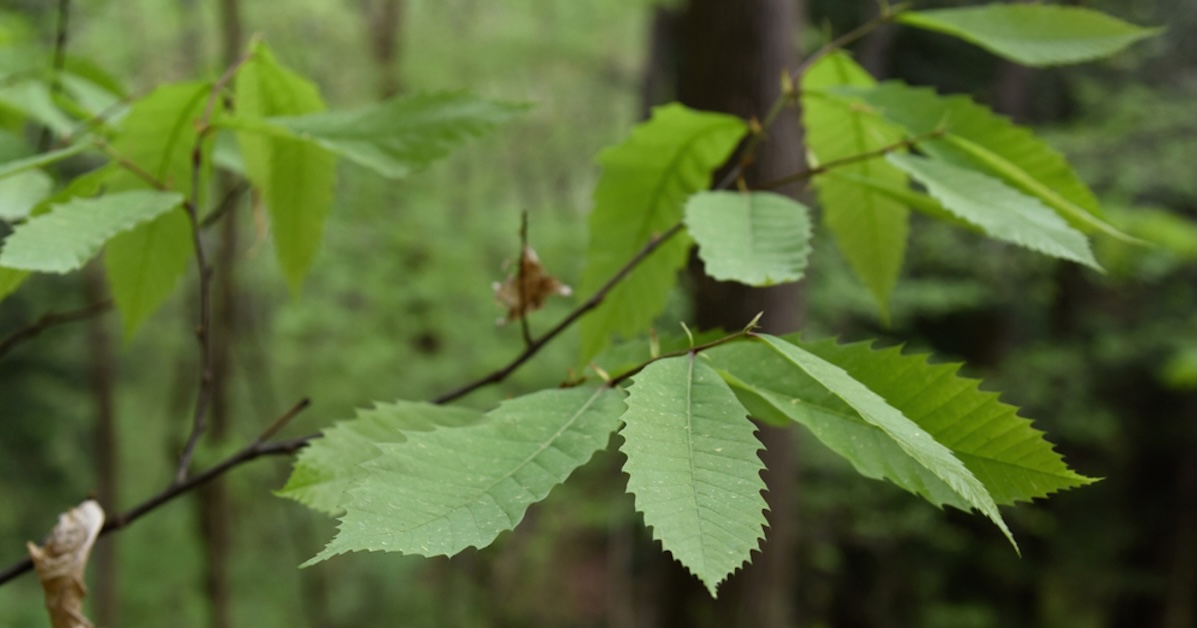
Crossing American chestnuts with naturally blight-resistant Chinese chestnuts results in hybrids with substantial blight resistance; GM trees continue to disappoint. Report: Claire Robinson
The American chestnut tree is widely considered to be on the brink of extinction in the United States, due to widespread infection by an imported pathogenic fungus that causes chestnut blight, even though some wild American chestnuts continue to thrive. Much-hyped attempts to genetically engineer blight-resistant American chestnuts have proved a miserable failure.
Now, in what Glenn Davis Stone, Senior Research Professor of Anthropology and Environmental Studies at Washington and Lee University, called a “giant leap forward in American chestnut restoration”, scientists have found that crossing American chestnuts with naturally blight-resistant Chinese chestnuts results in hybrids with substantial blight resistance, as well as resistance to another problematic disease called root rot. The hybrids have around 70% American chestnut ancestry.
In addition, the scientists used genomic selection (a similar technique to marker assisted selection – neither results in a GMO) to predict pathogen resistance before planting and hybridisation, thereby enhancing breeding efficiency.
The scientists conclude: “Recurrent selection within hybrid populations remains a key approach to enhance disease resistance and forest competitiveness while representing genetic diversity from remnant C. dentata [American chestnut] populations.”
GM tree failure
One of the authors of the new paper is Sara Fitzsimmons of The American Chestnut Foundation (TACF), who in 2022 was promoting the supposedly blight-resistant GM American chestnut, the development of which the Foundation supported. At that time Fitzsimmons claimed the genetically engineered resistance was “superior to anything we’ve been able to do through traditional breeding”.
But in a shock announcement in 2023, after participating in the GM project for over 11 years and providing over $2 million in funding, TACF said they were withdrawing support for the GM tree, as well as for petitions for regulatory authorisation for planting it in the wild. TACF said the decision was due to “significant performance limitations” – the trees’ poor blight tolerance, substandard growth, and increased mortality.
It also turned out that researchers at the State University of New York College of Environmental Science and Forestry (SUNY ESF), who developed the GM tree, had mistakenly given the wrong GM tree line to TACF for testing – previously believed to be a variant called D58, it was actually another variant called D54. None of this has deterred the SUNY ESF researchers from persisting in trying to push the known-defective D54 through the US regulatory process with the aim of releasing it into the wild.
GM approach continues to disappoint
Ongoing disappointing results from the GM approach are reported in the new paper: blight canker severity ratings among the GM trees varied widely, and cankers on 13% of trees with the highest year-1 resistance ratings continued to expand in subsequent years. Also, the GM trees grew 22% slower compared with non-GM siblings, which the scientists concluded “may be a pleiotropic effect” of the inserted transgene.
A pleiotropic effect is one in which a single gene influences multiple traits or biological processes. In addition, it is important to bear in mind that far greater genetic pleiotropic effects, which the authors do not mention, stem from the genome-wide DNA damage resulting from the transgenic genetic modification procedure as a whole (plant cell tissue culture and plant cell GM transformation). Studies have shown that the combination of these pleiotropic effects can give rise to large scale changes in gene expression (function) patterns and consequent alterations in the plant’s biochemistry and composition.
Pleiotropic effects are a major weakness of genetic engineering technology and may explain why it has largely failed to produce desirable products – and why some GM crops have unexpected downsides.
For example, pleiotropism is likely responsible for the consistently lower yields of GM herbicide-tolerant soy compared with non-GM soy.
In the case of the GM chestnut trees, the researchers remind us that the inserted transgene has been found to interrupt a native gene governing the tree’s growth and stress response. Probably due to this genetic disruption or the activity of the inserted transgene, the researchers had trouble producing GM trees that had two identical forms (alleles) of the transgene (called “homozygosity”).
Homozygosity is a primary goal of the many genetic engineering programmes, including the one involving the American chestnut, because it results in genetic stability of the desired trait. When homozygosity is not achieved, the result is hemizygosity, where the GM plant has only one copy of the transgene. The most positive finding that the GMO researchers could present in this case was that 4% of the hemizygous GM trees had both high resistance ratings and height growth comparable to the non-GM controls.
Fundamental oversight
Molecular geneticist Professor Michael Antoniou commented: “Not checking the transgene integration site when initial GM chestnut tree selection was undertaken evidently constitutes a fundamental oversight by the developers. By determining transgene integration, candidate GM trees could have been selected where crucial host gene(s) were not disrupted. These could then have been taken forward for further evaluation.”
Nevertheless, in a triumph of faith over experience, TACF still hopes genetic engineering can succeed. The researchers are persisting with “larger field trials… to determine whether the resistance and growth” of the GM trees “are sufficient for forest restoration”.
Meanwhile, thousands of wild, healthy American chestnut trees are flourishing on the Maine forest land of the biologist and author Dr Bernd Heinrich. Their vigorous natural growth – and possible blight resistance – directly counters long-held beliefs that the iconic species survives today only as scattered, doomed sprouts.
Image: Shutterstock (licensed purchase)