



 Dr Michael Hansen says the US’s war against Iran is triggering desires to protect white phosphorus production. Report: Claire Robinson and Jonathan Matthews
US President Trump has invoked the Defense Production Act to protect the domestic production of elemental phosphorus and glyphosate-based herbicides (GBHs), such as Roundup.
The order also provides “immunity” to the makers and sellers of GBHs for any damages resulting from compliance with the rule. The move by the White House comes as Roundup maker Bayer is facing tens of thousands of lawsuits alleging the company’s glyphosate herbicides cause cancer and the company failed to warn farmers and other users of the risks.
The order may also be a strategic attempt to influence the US Supreme Court, which is scheduled to hear a major glyphosate-related case (Monsanto v. Durnell) on 27 April 2026. In the case, the US Justice Department is urging the Supreme Court to erase billions of dollars of Bayer’s liability for Roundup – placing the weight of the executive branch on the side of a foreign company against thousands of Americans who say Bayer’s products caused their cancers. And as the science director for the Center for Food Safety, Bill Freeze, has pointed out, the order “was released the week before Monsanto’s brief to the court was due, which then repeatedly quoted and relied on the order”.
But Dr Michael Hansen, senior scientist for Consumer Reports, believes GBHs, important as they clearly are to the US government, may still be secondary to the main thrust of the executive order – elemental phosphorus. At a time when Trump and Israel were gearing up for war against Iran, the chief preoccupation may well have been weapons.
As Dr Hansen points out, the beginning of the executive order notes, “Elemental phosphorus is… crucial to military readiness and national defence. It is a key component in smoke, illumination, and incendiary devices”. Dr Hansen says: “The reference to ‘smoke, illumination, and incendiary devices’ points to white phosphorus munitions. White phosphorus is not banned internationally because it has legitimate uses, such as for smoke screens and illumination. However, Article 2 of Protocol III of the 1980 Convention on Certain Conventional Weapons, concerning incendiary weapons, bans the use of white phosphorus incendiary weapons, particularly in civilian areas. Thus, there is a legal grey area here.
“Three companies in the US are associated with making, storing and exporting white phosphorus munitions: Pine Bluff Arsenal, Monsanto/Bayer and ICL Group. Pine Bluff Arsenal (PBA), opened in 1941 and owned and operated by the US, had a mission to supply chemical weapons for use in WWII. PBA is the only place in the Northern Hemisphere that currently fills white phosphorus munitions. Monsanto – which has a long history of working with the US Defense Department (such as with Operation Ranch Hand) – is the only US manufacturer responsible for white phosphorus production in the US and has been supplying PBA with the product for decades.
“The third company involved is ICL Group (previously known as Israel Chemical Ltd), which has a US chemical manufacturing plant in St Louis, MO and works closely with Monsanto/Bayer. ICL Group’s parent company, located in Israel, is a minerals company that, among other things, mines phosphates in the Negev desert and sells fertilisers. It’s thought that ICL Group US might provide Monsanto/Bayer with the phosphates used in white phosphorus production.
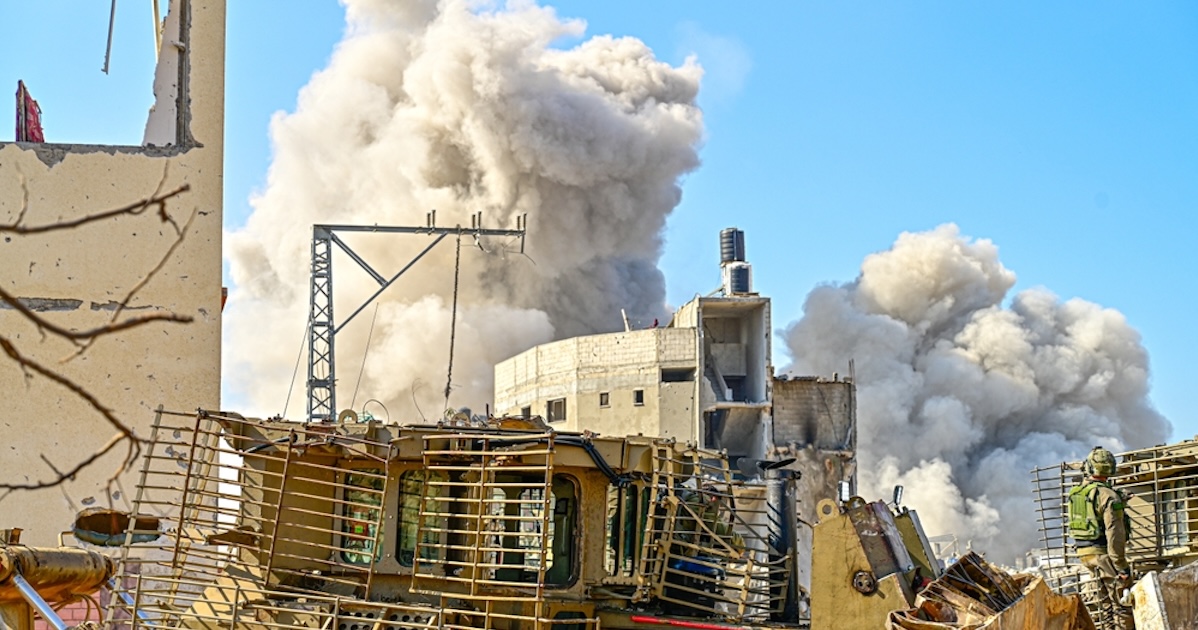
“Right after the October 7, 2023 attack on Israel, Human Rights Watch documented the use of white phosphorus munitions in Gaza and Lebanon. At the same time, Amnesty International documented that Israel used white phosphorus munitions from Pine Bluff Arsenal. In early November 2023, the Middle East Monitor documented that the IDF [Israel Defense Forces] dropped white phosphorus munitions on the UNRWA school in a Gaza refugee camp.
“So, the whole executive order is economically beneficial to Monsanto/Bayer, by helping them produce and sell more GBHs, potentially providing immunity from present lawsuits, and securing more white phosphorus for… war with Iran.
“The timing of this executive order seems suspicious. If the main reason was to help Monsanto with GBH liability, why now and not six months ago or one year ago?
“The bottom line is that since virtually all the white phosphorus munitions in the developed world are packaged at PBA, with Monsanto/Bayer being the sole US manufacturer of white phosphorus, and with documented use of white phosphorus munitions from PBA being used in the Middle East in the last couple of years and with the [build up to] war with Iran (which could conceivably involve greater demand for, and use of, white phosphorus), this PBA-Monsanto/Bayer-ICL Group connection should be looked at more closely.”
Weapons of war/Weapons against nature
Those puzzling over Trump’s turning of a weedkiller into a national security issue have seized on “the extraordinary number of Bayer-linked personnel in Trump’s inner circle and in high-level agency positions”. But as William Boyd, Professor of Law at UCLA, points out, “as a way to placate and protect a German multinational chemical company”, this executive order “is beyond extreme”. Such an invoking of a Korean War era statute – the Defense Production Act dates from 1950 – would only make some kind of sense, he suggests, in “the context of wartime and other similar emergencies”.
While Boyd doesn’t place it in that context, Michael Hansen’s analysis does exactly that. And if Hansen is right, then it would suggest that the Trump administration may not have succumbed just to the hugely influential Bayer/Big Ag lobby, but also to the arguably more powerful Israel lobby, not to mention the might of the military-industrial complex.
The chemical industry has long been a key part of that complex, as the corporate records of both Bayer and Monsanto testify. Monsanto played a critical part in the Manhattan Project, which developed the first atomic weapons, quite apart from its infamous role in Operation Ranch Hand, where it produced the largest (and dirtiest) quantity of Agent Orange that the US military deployed in Vietnam, Laos, and Cambodia.
The US’s herbicidal warfare that Monsanto did so much to enable was designed not just to remove forest cover but to destroy food crops. And Israel has been similarly accused of using aircraft to spray glyphosate-based herbicides extensively over agricultural areas in an ecocidal campaign aimed at making areas uninhabitable in southern Lebanon, as well as in Gaza and Syria.
The UN has repeatedly expressed its concerns over Israel’s military use of such a “highly toxic herbicide” as glyphosate, noting that “Attacks on farmland and water sources pose a serious… humanitarian risk”. Some of the areas sprayed with glyphosate have also been previously hit by white phosphorus, leading to accusations that both are part of a deliberate scorched earth policy.
Of course, intensive agriculture’s chemicals are often repurposed war chemicals. The nitrogen and phosphorus used for munitions in the two World Wars of the 20th century were subsequently channelled into agricultural use to make fertiliser and pesticides. And Bayer morphed from making chlorine gas to kill people, to making pesticides to kill various forms of life in agriculture.
The chemical companies’ war against people is also a war against nature, in which people’s health is collateral damage. And Trump’s executive order is a “call to arms” that promotes and escalates both wars.
Image: Ran Zisovitch / Shutterstock.com (licensed purchase)