




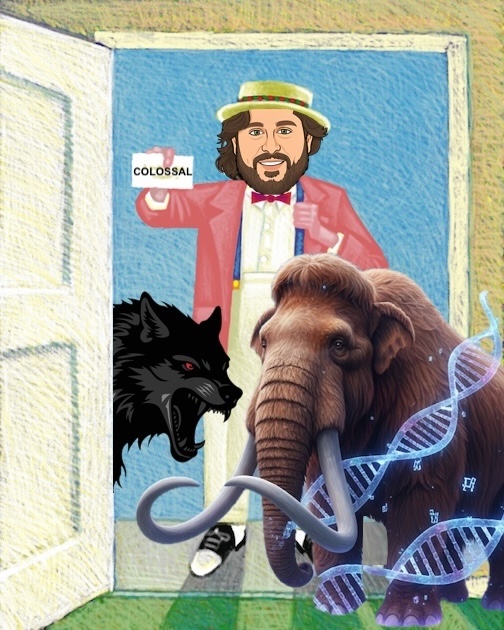
 How Colossal Biosciences’ CEO Ben Lamm keeps the hype cycle going. By Jonathan Matthews
In our first article in this series, we investigated the dark PR tactics that have accompanied Colossal Bioscience’s de-extinction disinformation campaign, in which transgenic cloned grey wolves have been showcased to the world as resurrected dire wolves – a species that went extinct over 10,000 years ago, and from which grey wolves diverged anywhere between 2.5 to six million years ago. And we noted how although Colossal’s co-founder and CEO, Ben Lamm, denied all involvement in the accompanying smear campaign against the company’s critics, he has happily joined in with the smears against its principal target – the evolutionary geneticist Vincent Lynch, leading Lynch to compare his actions to those of a “schoolyard bully”.
In this second article we look into the business background of Ben Lamm, who founded Colossal with the Harvard geneticist George Church, and why it might cast light on how Colossal came to be built around what the British geneticist Adam Rutherford calls “a con, full of gloss, bullshit and ghoulish greed”.
Hypergiant or giant hype?
Interestingly, Colossal’s CEO appears to have no background in science, nor any involvement in conservation prior to co-founding Colossal. But Ben Lamm does have a Bachelor of Business Administration and is most frequently described as a “serial entrepreneur”, with his net worth being put by Forbes at $3.7 billion, as of 2025. Forbes attributes the vast majority of that to Colossal and not to the five tech-sector firms Lamm previously founded and later sold on.
The last of these was Hypergiant, launched in late 2018 and described by Forbes as “an AI-enabled decision-making software company”. More importantly, according to Lamm, it was a company out to “solve the greatest challenges facing humanity”. “Our tagline is ‘tomorrowing today’,” Lamm told D Magazine. “We were promised hover boards. Where’s my vacation to Venus? There’s been all these wild promises. So our whole thesis is, why can’t we build a company that can deliver on that promise?”
In this spirit, a promotional video titled A Better World assures us that Hypergiant will be the company to transport humanity to a future of “smart cities, flying cars, a cure for cancer and longer lives”. The video, narrated by Bill Nye, who Lamm enticed onto Hypergiant’s board, also says Lamm’s company, which had outposts in Dallas and Houston and divisions called Galactic Systems and Space Age Solutions, wasn’t just going to create a better world but “a better universe”. And while it didn’t mention any specific projects or products that would achieve this, Lamm told Inverse, a digital publication focusing on geek culture, that Hypergiant was working on building an interplanetary internet. “What it will create,” Lamm explained, “is the infrastructure in space for humanity to eventually become a multi-planetary species”.
Lamm also penned a column entitled Entrepreneurs in Space: Musk Shouldn’t Have Mars All to Himself, which assured potential investors that “The opportunities in space exploration, tourism and colonization are vast, if you know where to look”.
Fixing the earth’s CO2 problem
But it was a more earth-bound product – one featured by Fast Company as a “world-changing idea” – that garnered the majority of Hypergiant’s extensive press coverage. The product would even become part of a museum exhibition – at the Smithsonian, no less – that featured hopeful solutions for the future.
Hypergiant’s “world-changing” product was its Eos bioreactor which, Forbes informs us, “uses AI to optimize algae growth and carbon sequestration” to “take on climate change”. The company claimed this was done by using its AI-enabled decision-making software to constantly monitor and manage “the amount and type of light, available CO2, temperature, PH, biodensity, harvest cycles, and more” to “create the perfect environment to maximize carbon sequestration”.
As a result, a single refrigerator-sized Eos bioreactor, Lamm explained, “sequesters the same amount of carbon from the atmosphere as an entire acre of trees. With enough Eos devices, we could make whole cities carbon-neutral or even negative, and at a rate that is so much faster than that of trees. That’s the dream: breathable, livable cities for everyone and right now.”
And, just as remarkably, as well as capturing “carbon from the air with 400 times the efficiency of a tree”, the algae inside the AI-optimised bioreactor could convert that CO2 into a biomass that “can be used to create carbon negative fuels, plastics, textiles, food, fertilizer and much more”.
Faking it without ever making it?
According to another 2019 article, Lamm’s company planned “to reveal details about how it will bring the product to market next year”. But despite Hypergiant claiming that it had “launched the Eos Bioreactor to critical and industry acclaim and it is now being considered for use by five nations, a number of cities, and lauded by the head of the UN COP26 committee”, no plans to market it have ever emerged. Nor, needless to say, have the interplanetary internet, the flying cars, or the cure for cancer.
Meanwhile, according to wildlife conservation biologist Ronan Taylor in an article that looks at Lamm’s entrepreneurial history, Hypergiant was sold off in 2023 to the private equity firm Trive Capital, with one former employee stating on Glassdoor, “There is no secret sauce, there is no product, there is no money, just Hype”, and another commenting, “This isn’t a software company, it’s VC [venture capital] marketing hype”.
As for that Eos bioreactor that graced the Smithsonian, Taylor says he attended that “Futures” exhibition and remembers “thinking that it was essentially a dumping ground for failed prototypes from a variety of companies”. That doesn’t mean, he says, that Hypergiant hasn’t impacted the CO2 problem that Lamm was dedicated to solving. But instead of its AI-super-boosted bioreactors delivering massive carbon sequestration, the impact came from use of its “satellite software to find new fossil fuel reserves”. In other words, the company made money not by fixing the CO2 problem but by helping the oil and gas industry accelerate it.
A taste for the fantastical
Profiles of Hypergiant’s co-founder, Executive Chairman, and CEO almost invariably use Lamm’s tagline, “dedicated to making the impossible possible”. And this taste for the extraordinary doesn’t seem to be confined just to marketing hyperbole, as was evident in his most recent appearance on Joe Rogan, where, as well as discussing de-extinction, Lamm shared his interest in the fringe archaeological theories of those like former journalist Graham Hancock, whose ideas have long fascinated him. Although there is a consensus among archaeologists that Hancock’s tales of survivors of a lost advanced Ice Age civilisation transmitting their knowledge to the ancient Egyptians and other ancient peoples don’t merely lack empirical support but have stacks of evidence debunking them, that hasn’t stopped Lamm appointing Hancock to Colossal’s Cultural Advisory Board, to help ensure “we navigate our business objectives with cultural integrity”.
Lamm also lists “ancient aliens”, along with “science fiction”, among his key interests outside of work. The reference is to the American TV series of the same name about extraterrestrials wandering the earth long ago, seeding human civilisation among naïve indigenous peoples who welcomed them as gods – an idea, originally popularised in books like Erich von Daniken’s Chariots of the Gods?, which even Graham Hancock dismisses as too far-fetched to be credible.
In the synthetic biology pioneer George Church, Lamm came across yet another beguiling storyteller who could fire the popular imagination. But this compelling communicator had a considerable scientific reputation. And his tall tales weren’t about some distant past but how synthetic biologists were currently developing the technical wizardry to conjure up the fantastical – astronauts made radiation-resistant for interplanetary travel and settlement, vast supplies of bioreactor-brewed renewables almost too cheap to meter, “mirror humans” rendered utterly immune to all natural viruses, and – most buzzworthy of all – long-extinct species brought back from the dead, à la Jurassic Park. Lamm, forever the entrepreneur and with sci-fi tastes, quickly recognised that Church’s “vision” and his “world-changing technology” were highly marketable. And so what would become a multi-billion-dollar de-extinction company was born.
Flights of fancy – real world consequences
As we shall see in the next article in this series, if Lamm’s history suggests someone already too steeped in Silicon Valley’s “fake it till you make it” culture, then Church, for all his undoubted technical brilliance, was the last person to rein in Lamm’s hucksterish flights of fancy.
Lamm’s extravagant claims for how Hypergiant’s tech was going to achieve “the dream” of “breathable, livable cities for everyone and right now” while enabling the production of a whole stream of critically important “carbon negative” products, are fully consistent with his declaring in a press release for the 2021 launch of his new start-up with Church, “Never before has humanity been able to harness the power of this technology to rebuild ecosystems, heal our Earth and preserve its future through the repopulation of extinct animals”.
And for four years Lamm has kept the de-extinction hype cycle building via the media circus his company has created around a growing catalogue of iconic extinct creatures they say they’re working to resurrect. Recently Colossal has managed to generate even more media excitement with the unveiling of what Adam Rutherford calls their “gaudy boutique animals”: lab mice engineered to grow shaggy golden-brown hair “like the extinct woolly mammoth” and grey wolves engineered to resemble long-extinct dire wolves, or at least Ghost in Game of Thrones.
Colossal’s carefully orchestrated PR stunts have brought investors, including Hollywood celebrities, flocking and turned Lamm into a billionaire, not to mention one of TIME magazine’s “emerging leaders … shaping the future”. But fuelling a media circus around magical solutions to “take on climate change” and “rebuild ecosystems, heal our Earth” lodges false techno-fixes in the public consciousness that obstruct real attempts to address contemporary crises – like climate chaos and an accelerating extinction rate that has biodiversity going into rapid decline. And if Church is not the man to rein in Lamm’s hucksterism, he is equally incapable, as we shall see, of providing him with the firm ethical guardrails to avoid greedily exploiting these urgent crises with schemes for passing off the impossible as the possible.
Image sources for salesman, mammoth, dire wolf: Shutterstock (licensed purchases). Image of Ben Lamm created by GMWatch.