



Our last Review – Glyphosate, Fire and Science – looked mainly at the new studies showing the multiple harms of glyphosate and at the growing evidence that glyphosate safety reviews were ghostwritten by Monsanto. We also looked at the damaging use of glyphosate to convert wild public forestlands in the US and Canada into poisoned flammable tree farms.
Not long after we published that Review, our website suffered a sophisticated cyber-attack that drove it off-line and which we are still in the process of recovering from. Please see our appeal for support and help us to recover some of the costs of the attack and to keep doing the work that is causing such annoyance!
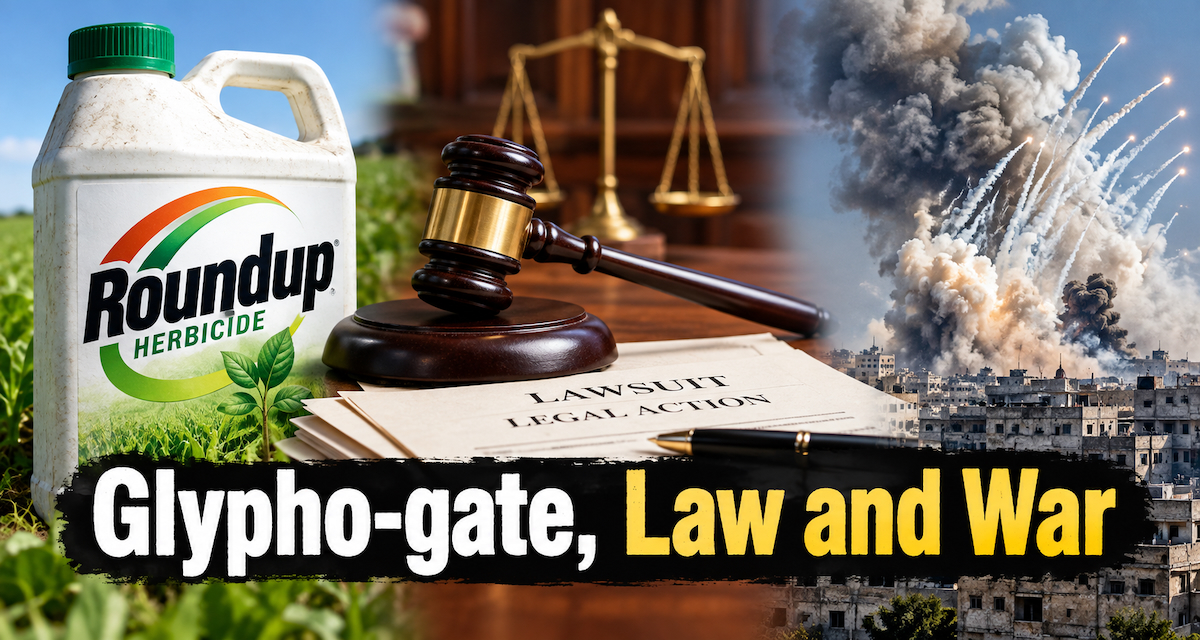
In this follow-up Review we focus on the massive legal and political developments that have been taking place on the glyphosate front in the US, where Bayer’s desperate quest to be shielded from ongoing litigation over the harms caused by Roundup has reached a climax during the last few months. That’s after three years of intense lobbying across all levels of government, targeting state capitals, Congress, the White House, and the Supreme Court.
Legislative battles across 15 states
At the state level, the lobbying campaign (led by Bayer’s big-spending Modern Ag Alliance) has produced little of note, thanks to massive pushback from grassroots protesters. It suffered defeat after defeat in 12 out of the 15 states where it introduced pesticide liability shield bills – in many states suffering multiple defeats between 2024 and 2026.
The millions spent on lobbying paid off in just three states: Georgia, North Dakota, and Kentucky. And even in Kentucky, it only succeeded at the second attempt and after overriding the veto of Gov. Andy Beshear, who accused the bill’s supporters of slamming “the door shut on citizens’ access to courts” in a state that “consistently has the highest rate of cancer diagnoses and deaths in the nation”.
What made this fierce pushback particularly galling for Bayer is it had anticipated easy legislative wins in the specific 15 states it targeted, thanks to their Republican-controlled legislatures and powerful corporate farming lobbies. But even in the agricultural states with major Bayer facilities and vast acreages of Roundup Ready crops, it still suffered repeated rejections.
And despite an extensive public-facing ad blitz that took in everything from local TV and radio placements to billboards, newspapers and social media, triggering complaints of being deluged with “Monsanto’s propaganda”, public sentiment remained overwhelmingly hostile. In Iowa, for instance, 87% of registered Republicans opposed giving chemical companies like Bayer immunity.
Trounced on Capitol Hill
At the federal level, where Bayer lavished more millions on lobbying, it met an equally fierce wall of resistance when it tried to bury a pesticide liability shield inside the 2026 Farm Bill. In the House of Representatives, lawmakers on both sides of the aisle condemned the measure, with Thomas Massie declaring that despite Washington being “under siege” by lobbyists, Congress must protect “people over poison” rather than “grant legal immunity to a massive foreign corporation”.
In a dramatic floor vote, a bipartisan coalition – led by figures as politically distinct as Chellie Pingree, a progressive Democrat from Maine, and Anna Paulina Luna, a conservative Republican from Florida – successfully stripped the shield from the bill in a crushing 280–142 vote.
Supreme Court ruling in favour of Bayer
Just when Bayer seemed to be on the ropes, the US Supreme Court stepped in and swept those resounding democratic victories away, when it ruled by 7-2 for Bayer and effectively placed the pesticide industry above the law. Empirical research has found that the current Supreme Court is the most pro-business Supreme Court in at least a century. This ruling is no exception.
Below, in Part 1 of this Review, we look in detail at this devastating decision, the reactions to it, how it sets a dangerous precedent that will enable a wide range of corporate defendants to weaponise the Supreme Court ruling far beyond the Roundup issue, but why it may not be as comprehensive a victory as Bayer hopes (see LOWER COURT BATTLES).
We also look at the second prong of Bayer’s campaign to put an end to Roundup litigation – its proposed $7.25 billion class action settlement, which has been described as “the scariest, worst futures settlement that’s ever been contemplated”. Like Bayer’s Supreme Court victory, this could also set an incredibly dangerous precedent (see BAYER’S “FILTHY” DEAL). But even with this settlement, Bayer may still not be out of the financial woods (see NEW FINANCIAL FRONT AGAINST BAYER).
What’s next?
In our next Review (Part 2 of Glypho-gate) we will examine the critical role played by “The Glyphosate President” in bringing this ruling about. Unlike the Biden administration, which urged the Supreme Court to reject Bayer’s appeal, the Trump administration actively pressed the Court to take up the case and to rule in Bayer’s favour. And what really ‘greased the skids’ for such a ruling was the carefully timed executive order Trump issued on the crucial importance of glyphosate for ‘National Defense’.
As part of Part 2’s focus on this order, we will look in particular at its deep connections to weapons of war. We will also be looking at the storm of protest over the Trump administration’s uncompromising support for Bayer, the massive betrayal it represents of the Make America Healthy Again (MAHA) movement that helped get Trump elected, and the potentially powerful unified front emerging against corporate legal immunity. We will also look at the dirty tricks the Trump administration is deploying to try to shatter this budding bipartisan alliance.
US SUPREME COURT: BUILD UP
US EPA chief met with Bayer CEO over Supreme Court fight
Top US regulators met with Bayer’s CEO last year to discuss “litigation” issues – including “Supreme Court Action” over its glyphosate weedkiller – just months before the Trump administration took a series of steps to boost Bayer’s case at the high court, internal government records show.
Bayer’s CEO also met with top White House officials
Government and internal records show Bayer executives, including CEO Bill Anderson, held multiple meetings with senior Trump administration officials, including White House Chief of Staff Susie Wiles – one of 26 key administration officials with personal ties to Bayer’s lobbying or legal network, to press for federal intervention in its Supreme Court litigation over Roundup.
People vs Poison rally outside the Supreme Court
At The People vs. Poison rally outside the Supreme Court, one of the many notable speakers told the assembled protesters that the Bayer appeal that the Justices were then hearing amounted to a litmus test for whether the administration is truly serious about the MAHA agenda. Kelly Ryerson, a prominent MAHA activist and founder of the website Glyphosate Facts, said a ruling that strips people’s ability to file state-level failure-to-warn claims would be “catastrophic for public health”. “It would be entirely because of this administration, and it will be unforgivable.” Watch a short video with some speaker highlights here. For a full list of speakers, scroll down here.
US SUPREME COURT: CASE COMMENTARY
How did we get here?
The case that came to the Supreme Court is Monsanto vs Durnell. It arose out of Missouri, where a state court jury found that Roundup use caused farmer John Durnell’s non-Hodgkin lymphoma, and that Monsanto should have included a cancer warning on the product’s label. Durnell was awarded $1.25 million for the company’s failure to warn him. On appeal, the Missouri Court of Appeals upheld the lower court’s decision. It rejected Monsanto’s argument that the Federal Insecticide, Fungicide, and Rodenticide Act (FIFRA) expressly pre-empted (i.e. overrode) Durnell’s failure-to-warn claim. Monsanto had argued that because the EPA had concluded that glyphosate – the main chemical in Roundup – is not cancer-causing, its label did not need such a warning. While a different appellate court in a separate case had sided with Bayer on this issue, multiple other courts have, like the Missouri Court of Appeals, rejected Bayer’s pre-emption argument. The US solicitor general under the Biden administration also rejected it. However, Monsanto (Bayer’s subsidiary) appealed to the Supreme Court, which – after the Trump administration threw the full support of the US government behind the appeal – finally took up the case.
Legal expert on Roundup hearing
William Boyd, Professor of Law at UCLA School of Law, observed the oral hearing at the Supreme Court where Bayer and the Trump Justice Dept claimed that only the EPA’s judgements count, so if the EPA does not require a warning label nobody should be able to sue Monsanto-Bayer for failing to provide a warning. But the problem with this, Boyd notes, is Monsanto’s undue influence on regulators and their assessments of glyphosate, and how these assessments have ignored evidence of a cancer link, and have been based at times on ghostwritten science, and even on fraudulent laboratory work.
Legal brief: EPA consistently fails to warn about pesticide dangers
The pesticide industry and the Trump Justice Dept told the Supreme Court that the EPA’s regulatory system is so robust there’s no need for more protections. But the EPA’s track record shows it has failed catastrophically at assessing the health risks of dangerous pesticides (more than a quarter of all agricultural pesticides sprayed in the US consist of substances that European regulators have deemed too dangerous to allow). And, as the Center for Food Safety and a coalition of advocacy groups pointed out to the Court in a legal brief, even where the EPA has assessed pesticides as dangerous, it has repeatedly failed to require their producers to warn users of the dangers. Research shows of 4,919 different labels on products with active ingredients that the EPA classified as a “probable” or “likely” human carcinogen, only 69 of those labels contain a warning. In other words, the EPA has only required a cancer warning label on about 1.4% of products with known cancer risks.
Former EPA officials weighed in on critical Supreme Court hearing
Jim Jones is among a group of former senior EPA officials who weighed in on the glyphosate debate, filing an amicus curiae brief to the Supreme Court arguing against Bayer’s position. In an interview with journalist and author Carey Gillam, Jones said throughout his career at EPA he took the view that states play an important and complementary role in regulating pesticides and determining what types of warnings are warranted, and that role shouldn’t just be left to the EPA.
US SUPREME COURT: THE RULING
US Supreme Court rules in favour of Bayer-Monsanto
In its ruling, the US Supreme Court found in favour of Bayer-Monsanto by 7-2. The Court did not determine that glyphosate does not cause cancer or that EPA’s scientific conclusions are beyond debate. The Monsanto vs Durnell case specifically dealt with the question of whether a federal law that gives the EPA regulatory authority over pesticides pre-empts state claims that a company failed to warn users of certain product risks when the EPA itself has not required such warnings. “FIFRA expressly pre-empts Durnell’s state-law failure-to-warn claim,” reads the main opinion, pointing to the Federal Insecticide, Fungicide and Rodenticide Act (FIFRA). In effect, because the EPA approved a label, juries lost the ability to conclude that the label might be inadequate under state law. As a result, this ruling will block lawsuits filed by people alleging the key ingredient in Roundup causes cancer and that the company should have warned them of the dangers. It will also have a far wider impact by radically expanding corporate pre-emption – see items below.
Dissenting justices say ruling leaves victim with no remedy for significant harms
Not all justices agreed with the ruling. Justice Ketanji Brown Jackson wrote a dissenting opinion, which Justice Neil Gorsuch joined. This argued that pre-emption did not apply because federal law permitted Monsanto to add a cancer warning without first obtaining EPA approval; that adding a cancer warning would be in line with the federal law’s prohibition on misbranding; and that, “In accepting Monsanto’s argument and holding that Durnell’s failure-to-warn claim is pre-empted, the Court misunderstands FIFRA’s requirements, misinterprets the scope of FIFRA’s pre-emption, and ultimately leaves Durnell without a remedy for the significant harms he has suffered”. Scroll down at the link here for the dissenting opinion.
Ruling may quash thousands of cancer and Parkinson’s lawsuits
The Supreme Court’s decision means the failure-to-warn claims included in several thousand cancer-related lawsuits pending against Bayer cannot go forward. But the impact of this precedent goes far wider, taking in the whole pesticide industry, as it is similarly regulated. As a result, Syngenta is aggressively citing the Supreme Court’s decision to argue that in thousands of lawsuits pending against it the plaintiffs’ core failure-to-warn claims are legally dead. In the Syngenta cases, plaintiffs allege they developed Parkinson’s disease due to exposure to the company’s paraquat weedkiller. However, even though failure-to-warn claims cannot go forward, this may not doom other claims, such as design defect and negligence (see LOWER COURT BATTLES below).
Other corporate defendants weaponising Supreme Court ruling
Other similarly federally regulated industries outside of agriculture are going to claim sweeping immunity against state-level failure-to-warn lawsuits in the light of this ruling. These will include the pharmaceutical, medical device, food, and consumer product sectors. Leading corporate defence firms are already publicly advising their corporate clients that the Durnell ruling completely changes the game. In effect, if a company can get a heavily lobbied federal agency to approve its basic product packaging, the Durnell precedent grants them nationwide immunity from ever being sued for a failure to warn of hidden long-term health risks.
US SUPREME COURT: REACTION
Bayer wins but at what cost to public health?
In an interview with Deutsche Welle about the Supreme Court ruling, Nathan Donley, the environmental health science director at the Center for Biological Diversity, said Bayer had gained legal immunity to poison Americans and that Donald Trump, whose administration had engineered this result, is now “The Glyphosate President”. Donley told DW, “I think it’s probably hard for many Europeans to truly comprehend what an abysmal pesticide regulatory system looks like. But what we’ve got here in the US is run by EPA, which consistently fails to get dangerous pesticides off the market. And most people are left with having to sue the companies, like Bayer, for damages after getting sick. And that right has pretty much just been stripped away.”
Congress members move to override Supreme Court ruling on pesticide protections
US Rep Chellie Pingree, a Democrat from Maine, and Rep Thomas Massie, a Republican from Kentucky, have introduced an amendment to the Federal Insecticide, Fungicide and Rodenticide Act (FIFRA) – the key law for regulating pesticides. Under their proposed amendment (H.R. 9528) to FIFRA, people who are exposed to pesticides they blame for causing health problems would once again be able to sue companies for failing to warn them of health risks.
Luna introduces bipartisan bill to protect Americans from poisonous pesticides
Congresswoman Anna Paulina Luna, a Republican from Florida, joined by the original amendment cosponsors Reps Massie and Pingree (see item above), has introduced the Americans vs. Poisonous Pesticides Act. Luna’s primary co-lead is Rep. Rosa DeLauro, one of the most powerful and influential institutional Democrats in the House of Representatives. This legislation would also amend FIFRA in order to preserve state failure-to-warn claims and prevent manufacturers from using EPA registration or label approval as a complete defence against those claims. But Luna’s amendment – H.R. 9807 – is more legally robust and comprehensive than the earlier H.R. 9528. For instance, it is explicitly retroactive, protecting active lawsuits currently on appeal or remand.
Senate Republicans vote down Farm Bill amendment on pesticide liability
In August, Republicans on the Senate agriculture committee voted down (by 11 votes to 10, following strict party lines) a proposed amendment to the Farm Bill from Sen. Cory Booker that would have ensured pesticide manufacturers can once again be held legally responsible when they fail to warn of the dangers of their chemicals.
Emergency petition urges EPA to add cancer warnings to pesticide labels
The Center for Biological Diversity has petitioned the EPA to add cancer warnings to all pesticide product labels containing ingredients the agency has linked to cancer – something EPA fails to do in almost 99% of cases, as a recent analysis shows. “The EPA represented to the Supreme Court that it was fully capable of requiring warnings on pesticide labels when warranted, but the reality is it almost never does,” said Nathan Donley. “The sad fact is that for its entire 50-plus years of existence, the EPA has utterly failed at the job of protecting Americans from dangerous pesticides.”
LOWER COURT BATTLES
Supreme Court ruling may not end Roundup lawsuit litigation
Reuters reports that Bayer faces Roundup lawsuits from roughly 65,000 plaintiffs. Failure-to-warn claims are part of most of these and are generally considered easier to prove than other legal theories. Because of the Supreme Court, those claims are now pre-empted by federal law. But most of the lawsuits also raise negligence, misrepresentation and product defect claims that should survive, even though failure-to-warn will not. With product defect, for instance, a plaintiff can still argue that the chemical mixture inside the bottle is inherently defective, regardless of what the EPA-approved label says. Bayer’s strategy will be to try and argue in such cases that the Supreme Court’s ruling should doom these remaining claims as well.
Monsanto loses summary judgment bid hinging on Supreme Court’s ruling
On August 31, a Missouri Circuit Court judge issued what may be the first ruling in the country to test the scope of the Supreme Court’s Monsanto v. Durnell decision. Boone County Judge Jeff Harris denied Monsanto’s motion for a summary judgment in its favour, which would have ended Marvin “Kent” Shull’s Roundup lawsuit immediately without a trial. The judge ruled that the Supreme Court’s decision only addressed "failure-to-warn" claims, stating that “it would be an unwarranted expansion of its holding to extend it to design defect and negligence claims that were not before the Court.”
BAYER’S “FILTHY” DEAL
Bayer-Monsanto proposes $7.25 billion class action settlement in Roundup litigation
In a further bid to put costly US Roundup litigation behind it, Bayer announced a $7.25 billion proposed class action settlement for users of its glyphosate-based weedkilling products who have cancer now or develop cancer in the next several years. The Supreme Court’s recent ruling (see above) does not change the terms of the settlement, and Bayer has said it remains committed to moving forward with the deal. However, the deal faces severe criticism and could set a dangerous precedent (see following items).
Judge calls Roundup settlement a “filthy” deal
In 2021 Bayer filed a $2 billion class action settlement in the court of federal judge Vince Chhabria, who is in charge of multidistrict litigation (MDL) involving people suing Monsanto. Chhabria rejected it. So earlier this year, Bayer filed a new class action settlement not in Chhabria’s court, but in St Louis, Missouri, home to Monsanto. The judge in St Louis granted the deal preliminary approval in extremely dubious circumstances – with no transcription of the proceedings and without lawyers opposing the deal being given notice or allowed a hearing to air their concerns about the deal. Opposing lawyers responded by asking Judge Chhabria to weigh in on the deal. At a hearing, Chhabria condemned the deal as “filthy” and “mind-boggling”. He cited dubious ethics and overly complex procedures that fail to adequately protect Roundup users’ legal rights. But despite seeing numerous problems with the settlement, he didn’t see it as his role to address them – they can be taken up by other courts, he said.
Bayer-Monsanto’s $7.25 billion Roundup deal bombarded by objectors
“This settlement is the scariest, worst futures settlement that’s ever been contemplated.” That’s how prominent plaintiffs' attorney Gerson Smoger described Bayer’s $7.25 billion proposed class action settlement. He delivered this warning directly to Missouri Circuit Court Judge Timothy Boyer during the final fairness hearing on Monday, 14 September 2026, on behalf of a large coalition of objectors fighting the deal. Smoger and other objecting attorneys argued that the structure of the deal creates an unprecedented and highly dangerous legal template. Smoger noted that this is the first-ever settlement designed to bind people to a corporate agreement before they even get sick. It forces everyday citizens who are healthy today – but might develop non-Hodgkin lymphoma years from now – into a long-term, 20-year claims framework without their active consent. The deal also strips away the right to seek punitive damages – the heavy financial penalties used by juries to punish companies for bad behaviour. Smoger emphasised that by removing this risk for the next two decades, the settlement effectively allows Bayer-Monsanto to continue manufacturing and selling a carcinogenic product without fearing major financial punishment. Smoger warned the judge that if this deal is approved, it will become a corporate blueprint. Pharmaceutical and chemical companies would use it as a “prototype” to bypass major civil lawsuits by setting up cheap, future-proof class-action structures that silence future victims before they even know they are sick. But Bayer-Monsanto’s lead defence attorney presented the deal as a take-it-or-leave-it ultimatum, indicating that Bayer is prepared to walk away from the agreement and so flood the courts with individual claims it thinks it can probably win following its recent Supreme Court victory.
Deal offers rich payout to lawyers but “paltry” payouts to plaintiffs faced with medical debt
While a $7.25 billion total settlement sounds big, victims object that at an individual level, where payouts are capped between $10,000 and $165,000 based on age and severity, it’s paltry. Victims suffering from advanced non-Hodgkin lymphoma argue that $10,000 does not even begin to cover basic chemotherapy, lost wages, or health insurance deductibles, let alone compensate for terminal illness. Top trial lawyers note that very few victims will qualify for the maximum $165,000 cap. Instead, it will force terminally ill cancer victims into a strict, point-pinching system that pays out insultingly low amounts while attempting to legally shield Bayer-Monsanto from future liability. But Bayer has aligned itself with a powerful faction of class-action attorneys who stand to collectively clear $675 million in legal fees if Judge Timothy Boyer signs off on the deal, as observers think he is highly likely to do. The attorney Gerson Smoger also noted that in similar class action settlements that seek to resolve future claims, companies agree to stop selling the product at the heart of the claims. That is not the case with this agreement. Bayer will go on selling Roundup and with no warning label. “What they want is the end of anybody’s ability to have them punished for their conduct,” Smoger said.
NEW FINANCIAL FRONT AGAINST BAYER
Humana sues Monsanto over Roundup Medicare cost recovery
Humana, a major US health insurance giant, has filed suit against Bayer’s Monsanto to recover damages paid to members injured by the company’s weedkiller Roundup. The complaint, filed in the US District Court for the District of New Jersey, alleges that Humana was left responsible for the health costs of beneficiaries receiving settlement payments from Monsanto. The company seeks to recover damages equal to double the amounts Humana paid to treat Medicare Advantage patients injured by Roundup, including for non-Hodgkin lymphoma-related care. If Humana is successful in its suit, it could end up costing Bayer-Monsanto tens or hundreds of millions of dollars. But it would also set a precedent for other US health insurance companies to seek damages. If they prevail, the total industry clawback could cost Bayer billions of dollars, as well as destroying the cap on litigation costs that the company is desperately seeking.
GMWatch News Review archive
Review 605: Glypho-gate, Law and War – Part 1
- Details