



He needs to answer them satisfactorily before his promotion of a 'farmfree' future can be taken seriously, writes Chris Smaje
There’s a lot of agreement that the present global food system isn’t serving people or Earth systems well. What to do about it commands less agreement, with some surprising cross-political alliances.
For example, currents of mainstream left-wing thinking have converged with right-wing liberalism around a technocratic approach delivered at mass scale by governments and corporations, with little attention to the limitations of this state-corporate behemoth.
British journalist George Monbiot is a significant figure here. A sometime left-wing firebrand, he’s lately drifted into boosterism for corporate market penetration in the food system, albeit framed as ecological and social benefit, with ventures supported via a hedge fund that’s invested in fossil fuels and the arms trade, and by the deep pockets of the Bezos Earth Fund.
In his 2022 book Regenesis: Feeding the World Without Devouring the Planet, Monbiot deemed farming almost irredeemably destructive ecologically. The book culminated in a chapter called ‘Farmfree’, endorsing food from bacteria cultured in factories powered by renewable electrical energy using a process he (mistakenly) calls ‘precision fermentation’. This technology, he believes, represents “the beginning of the end of most agriculture”.[1]
In my 2023 book Saying NO to a Farm-Free Future, I probed Monbiot’s analysis of the food system, showing among other things he’d greatly underestimated the energy costs of manufactured bacterial protein, which at minimum are around four times as high as he’d claimed. Updating those figures, just to meet global human needs for protein alone via Monbiot’s favoured method would require nearly twice the wind and solar electricity generated worldwide in 2025 (more if needing to correct for the apparently lower digestibility of bacterial compared to farmed protein).[2] And that’s just the energy for in-factory production, not for the total process.
Monbiot didn’t take kindly to my criticisms and doubled down on his agenda, numerical errors and all. Still, I felt truth would ultimately triumph over hype. Indeed, private investment in the fermented alt-protein sector has dropped, its energetic implausibility as a mass food perhaps being one factor. Solar Foods, the company behind the process that Monbiot championed four years ago in Regenesis, reported half-year revenue of just €52,199 in 2026 despite €1.3 million marketing and sales expenses in that period. Its only food product on the market to my knowledge is an ingredient in an expensive protein drink aimed at the US health and performance sector. Feeding the world, it isn’t.
Yet Monbiot has recently reverted to championing ‘precision fermentation’ on various podcasts, while making wild accusations about the callousness of my position.[3] The latter are best ignored, but the technology seems to be doing the rounds again as the next great hope of the liberal-corporate commentariat, if not as a technology attracting serious new private investment. Monbiot is an important influencer, so it’s worth interrogating his position. Here, I’ll focus on five questions that I think he needs to answer satisfactorily before his claims can be taken seriously.
1. Where will the energy for bacterial food come from?
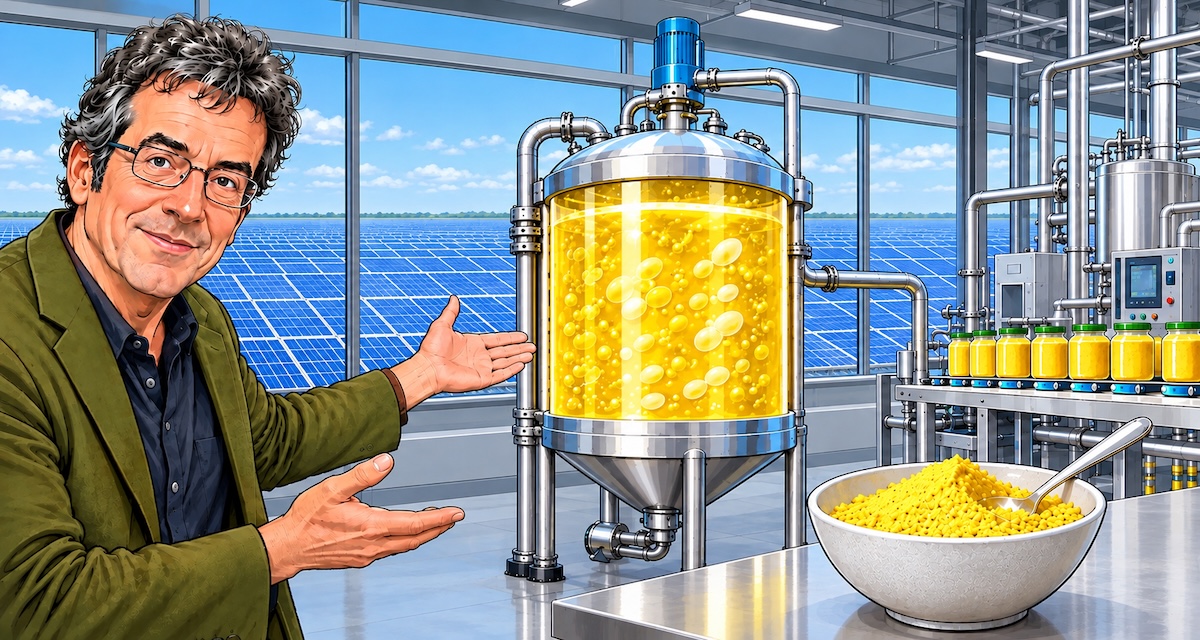
The factory process that Monbiot heralds as the end of most agriculture ideally uses solar panels or wind turbines to make electricity that splits water into hydrogen and oxygen – though in practice grid energy is used, which isn’t necessarily renewable or sustainable. The gases are fed to bacteria with various other chemical inputs and tap-water to make a slurry that’s dried for food use, supposedly replacing farm crops grown with zero-cost and zero-carbon sunlight.
Agriculture is the only major economic sector that can be energised largely by free sunlight. Most other industries have historically relied on fossil energy, which needs to be phased out rapidly in favour of low-carbon electricity in view of its climate effects. Currently, this isn’t happening (global fossil fuel consumption in 2025 was the highest in history), and there are difficulties in electrifying industries like metals and fertilizer. Precious low-carbon electricity should be prioritised for sectors that really need it – not for basic food production, which doesn’t.
A global rollout of bacterial protein would, at minimum, consume nearly twice as much solar and wind electricity as is being generated worldwide.[4] Monbiot has rightly written that “in any discussion of food and farming, unless your solution can be scaled to feed 8 billion people you shouldn’t be taken seriously”. Why, then, should bacterial protein be taken seriously?
2. How sustainable is mass urbanism without fossil fuels?
Although solar-energised agriculture can feed 8 billion, the sun’s energy falls diffusely across the Earth. That’s why historically people have been scattered geographically, tapping local solar flows through farming. Only recently with abundant fossil energy has it been possible to concentrate people heavily in cities, paying the energetic cost of moving food, water and other resources into cities and wastes out of them, while substituting human farm labour with machines and agrochemicals.
Whether present levels of urbanism can be sustained long-term depends on finding low-carbon substitutes for fossil fuels at similar levels of supply. Some believe an emerging solar electricity revolution can deliver this, but there are grounds for scepticism. Current global data don’t bear out the solar revolution thesis – fossil fuels account for 86 percent of global energy supply and we’re using more of them than ever.[5]
This energy-climate crunch may point to a future re-ruralization and re-peopling of a lower-energy farm sector as cities start losing the energetic capacity to support their dense populations. Unfortunately, the idea of deurbanization collides with a deep-seated modern progress ideology that disparages the rural and romanticises the urban. This makes it easy to portray low-energy, agrarian localist alternatives to technocratic approaches as either coldly authoritarian – think Mao or the Khmer Rouge – or as dreamy cottagecore fantasies. Monbiot and his allies have applied both labels to me.
However, this isn’t about political or lifestyle preferences. It’s about where our energy comes from. Ultimately, Monbiot isn’t arguing with me but with the sun, which is unlikely to rearrange its energetic gifts for the benefit of his preferred urbanism.
When techno-solutionism fails and the modern romanticisation of the urban clashes with the reality of energy or climate constraint, there’s a danger of chaotic and violent human population movements as people seek peace and prosperity where they can. This might be avoidable if we could approach deurbanization calmly, without seeing it as an affront to cherished ideals of progress.
Understanding the recent processes driving urbanization might help. Monbiot has argued that agrarianism is an impossibility because the urban skew of the global population would make the consequent reduction of long-distance trade a recipe for mass starvation – “you can’t,” he opines, “negotiate with arithmetic”.[6] But today’s urban skew isn’t a matter of arithmetic. It results from political and economic drivers that can change.
Again, Monbiot errs with his numbers on food transport, although it’s still true that major interruptions of global food trade would threaten human lives. But nobody is advocating for that. The breakneck urbanization of recent decades hasn’t arisen from ‘arithmetic’ but from complex politics around issues like trade liberalization, agrarian overproduction, population displacement and dispossession. All these can change, possibly to the point of putting urban populations most reliant on long-distance food trade at risk of starvation. Insouciance about present levels of urbanism puts future lives at risk. Perhaps Monbiot could explain why he thinks they will prove ‘arithmetically’ enduring?
3. How does the corporate cheap food system benefit the world’s poor people?
Monbiot implies that the plentiful cheap food produced by mechanized modern agriculture and the corporate supply chain behind it is necessary to keep people, particularly poor people, fed. This argument obviously suits corporate interests, but the equation cheap food = better-fed poor people does make some intuitive sense. However, the evidence suggests otherwise.
The modern global food system involves subsidised overproduction – too much grain, grown too cheaply in sparsely populated (and often colonially ‘pacified’), ecologically sensitive breadbasket regions using too much land, fossil fuels and agrochemicals, thanks partly to a flow of public money into the pockets of private corporations. The resulting torrent of cheap produce has undermined local agricultures, forcing farmers into the ranks of the precariously employed, underemployed or unemployed whose lack of economic entitlement puts them at risk of hunger. Cheap or not, food doesn’t automatically go to those who need it most.[7]
Since food and farming is the largest and among the least well-paid employment sectors globally, an increase in food prices could have positive anti-poverty effects. Poor people outside the food sector wouldn’t benefit, but nobody argues for increased food prices alone. A raft of economic measures is needed: ending the public-to-corporate subsidy pipeline, supporting job-creating local agricultures, limiting returns to economic rent in the economy generally and so on.
Ultimately, poor people aren’t poor because of food prices but because some people receive economic entitlement while others are denied it. The real solution to poverty is greater economic equality, not lower grocery bills.
But that would challenge the status quo, where money flows from governments and poor people to private capital. Monbiot seems politically aligned with this status quo, for example in reportedly helping secure “tens of millions of funding for precision fermentation startups from the EU Commission”. Perhaps he could explain why he supports such initiatives and associates himself with corporate ‘cheap food to help the poor’ talking points?
4. How do high crop yields benefit nature?
There’s an entrenched notion that high crop yields are a good thing, and a special achievement of modern large-scale mechanized agro-chemical agriculture. This isn’t completely wrong in every case but, given present overproduction, pursuing higher yields doesn’t necessarily make sense – it usually benefits input suppliers rather than food producers or consumers.[8] Nor are traditional local agricultures necessarily low yielding.
Various traps around the concepts of yield, productivity, efficiency, profit and cost await the unwary analyst of food systems, and Monbiot’s writings blunder into several of them. Here, I’ll address one such claim – that higher-yielding food production spares land for nature. This gets mobilised in the case for bacterial food on the grounds that the bacterial approach produces equivalent nutrition to farmed crops on a lower land footprint.
That’s questionable, but assuming it for argument’s sake, ‘land sparing’ does make some intuitive sense: if you can grow twice as much food per acre as another method, then you only need half an acre to produce the same amount. You’ve spared the other half-acre.
But spared it for what? It doesn’t follow that higher yields will prompt farmers to cut land-take to benefit nature. They might instead grow more crop (overproduction, again). For example, about 40 percent of the US corn crop is used to make bioethanol.[9] If corn yields increase in the future maybe there’ll just be more bioethanol (some of which could be used in farming to produce more corn – this is the perverse positive feedback cycle of overproduction). Or more of a higher value crop. Or of another use: golf courses, housing, tree plantations, airports etc. The land sparing framework involves numerous oversimplifications, and there’s little evidence linking specific yield improvements with specific preserved or increased wildlands. This has diminished its relevance in land use scholarship. But its power as a ‘policy legend’ in the wider world of politics, favouring business-as-usual options and marginalising non-elite voices, seems to have only grown.[10]
Land-sparing arguments depoliticise land issues. What happens to land is largely decided by the minority who own most of it or have power to make decisions about it. Land-sparing veils this, making it seem a technocratic matter. Doubtless this suits those involved in corporate crop development or large-scale landownership, but not necessarily anyone else. Arguments that mix up the higher profitability of large-scale, industrial food production with an allegedly higher yield have long been used by powerful interests to justify the expropriation of small-scale, distributed, local landowners and food producers. Some of Monbiot’s recent writings fit this shopworn enclosure narrative.[11] Can he at least explain how the wildlands supposedly enabled by the land-sparing capacities of bacterial food will be created in practice?
5. How can food safety and sovereignty be protected?
I mentioned that Monbiot mistakenly calls the process he champions ‘precision fermentation’, an industry term typically referring to the use of genetically modified microbes to produce pharmaceuticals, flavourings and analogues to farmed food components like milk protein.[12] The microbes are usually fed on other farmed products like glucose from sugar beet, so precision fermentation generally isn’t ‘farm-free’. In theory, with perfect filtration the final product should at least be GMO free, in the sense of being a more or less pure analogue of the target molecule without any remains or other derivatives of the genetically modified organisms used to produce it. However, research suggests this isn’t the case.[13]
Monbiot’s favoured process is instead a type of biomass fermentation. The bacteria currently used for it aren’t genetically modified, although the company behind it is involved in synthetic biology research – genetically modified bacteria may well be used in the future.
The advantage of this biomass fermentation for Monbiot’s ‘farm-free’ agenda is that it involves no farmed products. However, it uses plenty of other inputs and is certainly not, as its proponents sometimes claim, ‘food from thin air’. Biomass fermentation isn’t analogous to the fermentation familiar from products like bread – what’s eaten is the bacterial matter itself, not a farmed product like wheat that’s acted on by microbes in small quantities.
‘Yuk’ factor aside, that may not matter much. But in breaking the link with land, this biomass fermentation would remove a major obstacle in the food sector to the monopolistic concentration that rules other industries. There are also concerns about the health impacts of bacterial food. The European Food Safety Authority has repeatedly requested more toxicological data about the product, delaying its risk assessment in the interim. It’s surprising to hear Monbiot claim that “the big barrier is regulatory”, as if getting a corporate product to market quickly is more important than consumer safety.
Indeed, there’s a baffling disconnect between Monbiot’s general critiques of neoliberalism and his corporate-friendly positioning on food, with its questionable logic of capitalist market ‘discipline’ that has pushed so many farmers and former farmers into poverty and precarity worldwide. Perhaps he would care to explain the anomaly?
I’ve heard activists allege the industry has bought him off. I have no reason to believe this is true, but I fear it scarcely matters. What a blessing it must be for corporate food operators to have an apparently prominent critic replicating their talking points without paying him a penny. Unfortunately, it’s necessary to have a good grounding in food systems scholarship and history along with the time and discernment to read between the lines of his recent analyses to see how Monbiot’s positions align with corporate attacks on food sovereignty. I can calculate the unfeasible energy costs of bacterial protein, but alas the damage Monbiot is now doing to the prospects for a fair and sustainable food system I find incalculable.
Notes
1. George Monbiot. 2022. Regenesis. Penguin. p.187.
2. Chris Smaje, 2023. Saying NO to a Farm-Free Future. Chelsea Green, p.38. A more recent paper confirms that Monbiot’s figure was incorrect – see Mahdi Fasihi et al. 2025. ‘Global potential of sustainable single-cell protein based on variable renewable electricity’. Nature Communications. https://doi.org/10.1038/s41467-025-56364-1. For the updated 2025 calculations, see: https://chrissmaje.com/wp-content/uploads/2026/10/Electrical-Energy-Costs-for-Manufactured-Protein-2026-Update.pdf. On the digestibility of bacterial protein, see: https://www.sciencedirect.com/science/article/pii/S0963996926001419.
3. For example: https://savingtheworldfrombadideas.substack.com/p/bad-idea-58-environmentalists-are?tried= ; https://www.youtube.com/watch?v=t3IFlcWI224.
4. See: https://chrissmaje.com/wp-content/uploads/2026/10/Electrical-Energy-Costs-for-Manufactured-Protein-2026-Update.pdf.
5. Energy Institute – https://www.energyinst.org/statistical-review.
6. Monbiot, Regenesis p.146.
7. My claims in this paragraph are elaborated in, for example: Amartya Sen. 1990. Poverty and Famines. Oxford University Press; Farshad Araghi. 2009. “The invisible hand and the visible foot: peasants, dispossession and globalization” in A. Akram-Lodhi and C. Kay eds. Peasants and Globalization. Routledge; Mike Davis. 2002. Late Victorian Holocausts. Verso; Eric Holt-Giménez. 2019. Can We Feed the World Without Destroying It? Polity; Glenn Davis Stone. 2022. The Agricultural Dilemma: How Not to Feed the World. Routledge; Walden Bello. 2009. The Food Wars. Verso.
8. See: Glenn Davis Stone, The Agricultural Dilemma.
9. Vaclav Smil. 2024. How to Feed the World. Penguin, p.209.
10. For a thorough critique of the ‘land-sparing’ thesis, see: Claire Kremen. 2015. ‘Reframing the land-sparing/land-sharing debate for biodiversity conservation’, Proceedings of the National Academy of Sciences. 188 (26): e2015025118. On its role as a conservative ‘policy legend’, see: Adam Calo et al. 2026. ‘The legend of land sparing’. Agriculture and Human Values, 43(4), 164. https://doi.org/10.1007/s10460-026-10985-4.
11. George Monbiot, 2023 ‘The cruel fantasies of well-fed people’. For a wider historical critique of such arguments, see: Jim Handy. 2022. Tiny Engines of Abundance: A History of Peasant Productivity and Repression. Practical Action.
12. See, for example: https://blog.priceplow.com/podcast/solar-foods-solein-175.
13. Ravikishore Velamuri et al. 2026. ‘Multi-omics profiling finds synbio milk differs nutritionally from bovine milk and contains 93 uncharacterized fungal metabolites and 236 fungal proteins’. Scientific Reports. 16, 16029 https://www.nature.com/articles/s41598-026-38994-7.