“Given the evidence of a risk of serious or irreversible harm to the environment and human health, the precautionary principle must be applied” – biologist Erica Hagman Aguilar. Report: Claire Robinson
Mexico has approved the world’s first RNAi (RNA interference – a GM gene silencing technology) biofungicide – and scientists are warning about the risks. The technology “is not an innovation compatible with human rights standards”, biologist Erica Hagman Aguilar told the investigative news outlet Contralínea. This is because it fails to comply with the constitutional mandate of the precautionary principle regarding risks to public health and the environment.
The biofungicide, marketed as Oifirax, is specifically
approved to combat grape powdery mildew, a fungal disease caused by the pathogen
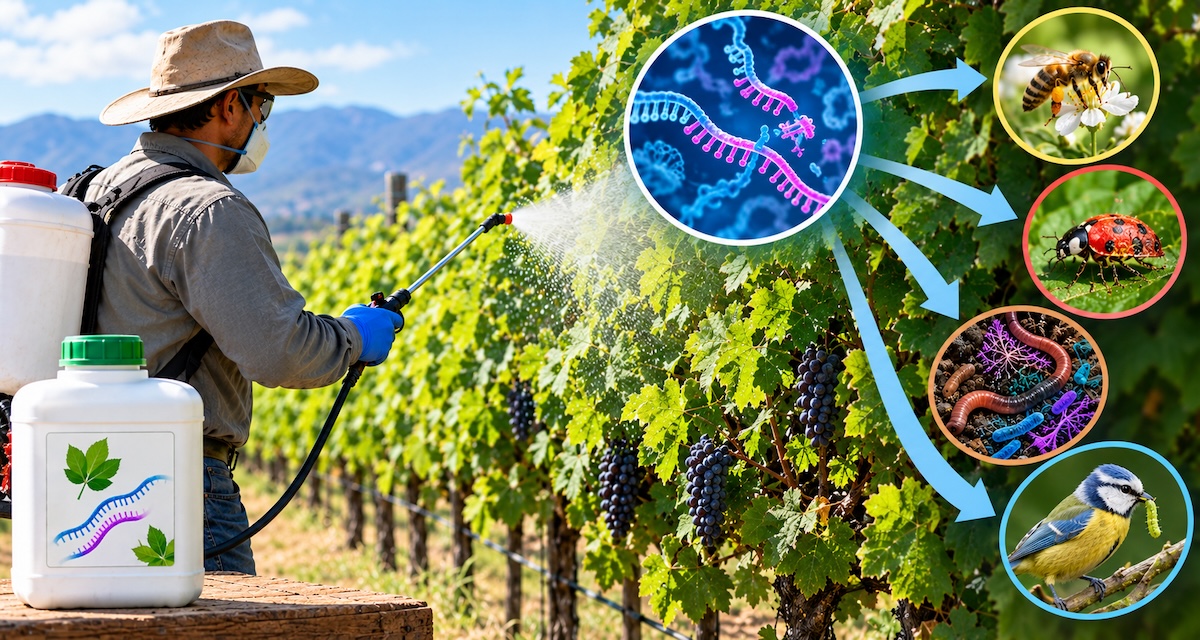
Erysiphe necator. The product uses targeted double-stranded RNA (dsRNA) via spray-induced gene silencing to deactivate genes in fungi that cause diseases in plants.
In a peer-reviewed paper, scientists have
warned that dsRNAs are remarkably stable in the environment, can remain intact after passing through the digestive systems of insects and worms, and can readily transfer to mammals through food where they can circulate in blood and alter gene expression in organs. The concern is that these molecules could silence or otherwise disrupt the genes of beneficial and non-target insects, as well as humans and other animals, with unknown but potentially fatal consequences.
Erica Hagman Aguilar, who was previously responsible for public policies and regulations at Mexico’s biosafety agency, told GMWatch: “RNAi technology is not precise... nor is it fully efficient in terms of specificity, as effects on non-target species have been reported in various studies. The situation is even worse in the case of fungi, which can develop resistance through their adaptive mechanisms and interspecies gene transfer. Could this resistance be transferred, or could the unspecific interference affect beneficial fungi in agricultural soils or human pathogens? The answer is that it is possible. This, in turn, has unpredictable genetic and epigenetic implications. Therefore, given the evidence of a risk of serious or irreversible harm to the environment and human health, the precautionary principle must be applied.”
Hagman Aguilar told
Contralínea that the risks relate to the impacts on both public health and environmental health. Therefore, a proper study is required, rather than one based on data from the private company promoting this technology under the auspices of federal authorities. The real costs, she added, must be compared with the alternative, which is agroecology, “and agroecology comes out on top. There are many and varied examples in Mexico that demonstrate this.”
Hagman Aguilar explained to Contralínea that potential environmental impacts always entail economic ‘externalities’ (in other words, those who own the technology make profits while everyone else pays the costs, such as environmental cleanup or health problems). She also criticised the fact that this is a privately-owned technology developed by a foreign company, which creates greater uncertainty regarding biosafety in Mexico.
In this regard, during the official announcement on 12 August, the economics minister Marcelo Ebrard and health minister David Kershenobich confirmed that the company set to produce the RNAi biofungicide is the US-based GreenLight Biosciences. They even named its founder and chief executive, Andrey Zarur, as the guest of honour.
They also acknowledged that no other country in the world has authorised the development of this technology: “Why are we holding this event? It is the world’s first RNAi biofungicide. This means that when you look in history books or science journals to see which country was the first in the world to register an RNA biofungicide, Mexico will be the one listed. This is important enough to warrant our gathering here today,” said Ebrard in his welcome address.
He added: “As you know, we are one of the most biologically diverse countries in the world. So, in addition to the achievement of carrying out this process and having the world’s first RNAi biofungicide – which in itself is significant enough – the next thing we must acknowledge is that its creator or principal sponsor chose to carry it out in Mexico.”
In addition to the Secretaries of Economy and Health, the director of the Federal Commission for Protection against Health Risks (COFEPRIS), Víctor Hugo Borja, was also present at the official ceremony; this body had already given its approval. This fact caught the attention of other scientists consulted by Contralínea, because the authorisation of this biofungicide was granted much more quickly than in the United States, the company’s country of origin. Furthermore – and in contrast with its rush to approve the RNA biofungicide – COFEPRIS has taken years to analyse the viability of 100 per cent Mexican bio-inputs for agriculture that do not pose any biosafety risks.
Regarding this fast-track approval, Hagman Aguilar compares it to what happened in the 1990s and 2000s, when what she calls the “political mafia” of the PRIAN (the two major political parties) approved the experimental cultivation of GMOs.
Scientific support for concerns
Strong support for Hagman Aguilar’s concerns has come from María Elena Álvarez-Buylla Roces, the former director of CONAHCYT – the national government agency responsible for coordinating science, technology, and humanities policy in Mexico – and the lead scientific advisor to the previous president López Obrador. She
says she shares “the concern expressed by scientists about the RNA biofungicide and considers it essential that developments of this kind undergo a more rigorous, independent, and transparent scientific analysis, fully applying the precautionary principle when there are relevant uncertainties about their potential effects on health and the environment.”
Other scientists, who are part of the “Sin Maíz No Hay País” (Without Corn There Is No Country) campaign, warned Contralínea that the risks posed by the world’s first RNA biofungicide are enormous, because insects and microorganisms that are beneficial to the environment – and which share genetic sequences similar to those of the pest being targeted – could be affected by the RNAi.
They also pointed out that although RNA degrades rapidly in soil and water, its persistence varies depending on climatic conditions or the encapsulation methods used. And they said that resistance may develop in pests and pathogens, as these can undergo genetic mutations that render the RNAi ineffective. This is something that already occurs with traditional pesticides.
For her part, Hagman Aguilar describes Ebrard and Kershenobich’s announcement regarding the world’s first RNA biofungicide as “the ABCs of the agribusiness propaganda handbook, promising once again to solve complex problems with a patented ‘innovation’ that only lines their pockets and leaves us with increasingly complex environmental, health and food security issues”.
She said that nothing the speakers said was of a scientific nature, and that they repeated fallacies: “There is no scientific evidence to demonstrate the safety of siRNA [small interfering RNA] pesticides; there is neither certainty nor scientific consensus; what there are, are studies showing that these techniques are inaccurate.”
She added that the way the issue has been presented is misleading: “At a genetic level, they silence a gene, and that sounds nice; but as the technique is not precise, they do not know whether the siRNA [small interfering RNA, a key molecular tool that triggers the broader biological process of RNAi] will ‘hit’ the targeted gene. Even if it does hit the target, any single gene is linked to the organism’s entire DNA, and that, in turn, affects a whole range of proteins and cascades through a series of metabolic processes; firstly, at the level of the whole organism; subsequently, at the population level of that species; and from there it impacts the ecosystem.”
For this reason, Hagman Aguilar warns that “they are using us as a testing ground to grow their business. While promoting gene-edited GMOs and biotech pesticides based on RNA interference, they are dismantling the expansion of agroecology and covering their tracks by supposedly ‘defending’ food sovereignty and ‘protecting’ native maize and the milpa [a traditional crop-growing system].”
Is this a U-turn?
These developments appear to sit oddly with Mexican President Claudia Sheinbaum’s move in 2025, when she successfully
pushed for a constitutional ban on the planting of GM corn in Mexico.
Did Mexico’s government do a U-turn? Not exactly. The government’s approval of the RNAi pesticide is based on Mexico’s pro-GMO regulatory framework, which has not been modified. That’s partly – or largely – due to pressure from the US through the World Trade Organisation and the United States-Mexico-Canada Agreement (USMCA), a free trade pact between the US, Mexico, and Canada.
In addition, the RNAi pesticide was promoted by the Secretary of Economy, with support from the heads of the ministries of health (along with COFEPRIS), agriculture (along with SENASICA), and the environment. Erica Hagman Aguilar told GMWatch: “None of these authorities is interested in strengthening biosafety for GMOs in Mexico. On the contrary, they are relaxed about, or even actively favour, these types of risky, patent-protected techno-scientific developments, while at the same time obscuring and marginalising agroecological practices and other forms of non-toxic agriculture that are freely available.”
And while Sheinbaum has not publicly spoken out in favour of GMOs or biotech pesticides, neither has she prevented their promotion and approval, or taken any public action to review or reverse them.
Another relevant factor may be Sheinbaum’s
restructuring and elevation in 2025 of CONAHCYT, headed up by Dr Rosaura Ruíz Gutiérrez. SECIHTI houses and oversees CIBIOGEM (Intersecretarial Commission on Biosafety of Genetically Modified Organisms), Mexico’s main federal body for coordinating biotechnology and GMO policy.
Ruíz has publicly promoted GMOs. Here are three examples:
- In a meeting with members of the Federal Government’s Cabinet and the Constitutional Affairs Committee regarding the bill to amend the Constitution concerning the conservation and protection of native corn varieties, Ruíz attempted to equate biological evolution, the domestication and diversification of crops by indigenous peoples, and conventional genetic “improvement” of corn and other agricultural plant species, with genetic modification through “modern biotechnology”, particularly gene editing. (Ruíz appears from minute 11 to 30:50, and then from 1:24:39 to 1:30:39.) Although she mentioned some unwanted effects of GM corn and says that it should be banned, she defends gene editing for corn and other agricultural species (from 1:28:00 to 1:30:39), even going so far as to say that we are all GMOs: “Broadly speaking, all living organisms are genetically modified because we have evolved and have different genes as a result of evolution.”
(GMWatch notes that this statement is legally and scientifically incorrect. The term “genetic modification” refers to the use of laboratory-based or laboratory-generated technology to directly manipulate and alter the DNA of an organism. In terms of the global human population, that means the term only applies, as far as is known, to the three CRISPR babies born in China as part of an unauthorised experiment that led to world-wide condemnation and the imprisonment of the scientist responsible. It’s also worth noting that genetic analysis later showed the editing resulted in mosaicism (their bodies unintentionally contain a patchwork of different cells: some fully edited, some partially edited, and some unedited), as well as unintended off-target mutations. Accidental edits like that, if they occur in critical genes, can disrupt cellular function, potentially increasing the lifetime risk of developing cancer, heart disease, or developmental defects. And, of course, any unexpected mutations or health issues created by these experimental errors can be passed down to future generations. In other words, not only are we not all genetically modified, but the outcome for the minute number who are hardly supports Ruíz’s glib promotion of gene editing.)
- A press release from SECIHTI paraphrased Ruíz as emphasising “the importance of incorporating technological advancements, such as advanced biotechnology and gene editing, to generate more efficient solutions, as well as ensuring their viability through robust regulatory frameworks and interagency coordination”.
- SECIHTI has called for public funds to be used to support gene editing, supposedly for the conservation of agrobiodiversity and in the name of strengthening “food sovereignty”. Hagman Aguilar and lawyer Raymundo Espinoza Hernández criticise this concept in an article. They write: “It is incongruous, illegitimate, and illegal for a government body to assume a priori that food sovereignty can be ‘promoted’ with biotechnologies for the genetic modification of living organisms, whether transgenic, genetically edited, or any other type of GMO... Agriculture and food systems that are fair and sustainable have never depended on corporations, GMOs, pesticides, patents, and certainly not on an agro-industrial oligopoly.”
These developments, promoted by Ruíz, have not been challenged or even addressed by President Sheinbaum.
Resistance against onslaught of agribusiness
On 29 September, Mexico’s National Day of Native Maize, the State Coalition in Defence of the Native Maize of Oaxaca (Espacio Estatal en Defensa del Maíz Nativo de Oaxaca) published a
statement in which the coalition’s member organisations protested against the government’s support for a new turn of the screw of agribusiness — characterised by dispossession of rural peoples, seed privatisation, new GMOs, and genetic pesticides. The organisations favour agroecology and traditional farming as the path to feeding the world and upholding life.
Maize was domesticated more than 9,000 years ago in Oaxaca, according to the oldest records available, and 30 years ago it was in that state that the fight against GMO corn was strongly consolidated, which led to the nationwide movement for the defence of native maize. Today, the Coalition is once again setting the tone for resistance against the onslaught of agribusiness.
The Coalition's statement says: “The Mexican government, through the Ministry of Science, Humanities, Technology, and Innovation (SECIHTI) and the Ministry of Economy, is promoting the use of various forms of genetic manipulation of crops, insects, and other organisms, which pose new environmental, biosafety, and health risks, as well as threats to Mexico’s communities and peoples. Examples include gene editing of crops, RNA-based pesticides, and GMO flies.
“They [the government and Ministries] are promoting the production of a new generation of genetically modified organisms without taking the precautionary principle into account. In a country with high biodiversity like Mexico, this would have very serious effects on the environment. Furthermore, these new technologies are in the hands of the very same companies that control agrochemicals and genetically modified crops, such as Bayer-Monsanto, Corteva, and Syngenta.”
The Coalition continues: “Let us continue to plant our native and local seeds, continue to exchange them among farmers, and continue to use the forms of reciprocity passed down to us by our ancestors, such as guelaguetza, gueza, gozona, or mano vuelta, which do not require money to solve our problems. We must not allow the leasing or sale of land that promotes land grabbing, and we must facilitate access to land for women and young people.”
Other commercialised gene-silencing pesticides
Mexico may have approved the first RNAi fungicide but it is not the first RNAi product to be approved globally.
In 2017 the US EPA gave the first regulatory approval for an RNAi-based pesticide to Bayer’s
SmartStax Pro corn, which combines two Bt toxin proteins with an RNAi trait called DvSnf7, targeting the rootworm pest. Corn when stacked with several engineered traits like this is known as “pyramid”. In this case, the corn plant itself produces the dsRNA internally to kill corn rootworms, rather than it being applied as an external spray.
However, the performance of SmartStax Pro seems to be unimpressive, according to a peer-reviewed
study. The study found that the RNAi technology (specifically the DvSnf7 trait) does not directly trigger rootworm resistance, but its efficacy in the SmartStax Pro pyramid is severely compromised by pre-existing rootworm resistance to Bt toxins. Because western and northern corn rootworms have already developed widespread resistance to the shared Bt proteins (Cry3Bb and Gpp34/Tpp35Ab), the RNAi trait is left to act as a single line of defence. The result is called “pyramid collapse”: when the Bt components fail, the overall efficacy of the SmartStax Pro pyramid drops, leading to immediate “cross-resistance” to the pyramid as a whole.
The first sprayable RNAi pesticide approved for commercial use is
Calantha (active ingredient Ledprona), registered by the US Environmental Protection Agency in late 2023/early 2024. Developed by GreenLight Biosciences, it kills the Colorado potato beetle by silencing a vital survival gene.
This year the Belgian Federal Government
granted a temporary “emergency” approval for Calantha, despite concerns over a lack of data on health and environmental risks.
Environmental groups Nature & Progrès and POLLINIS
announced they had filed an appeal with the Council of State to overturn the emergency authorisation granted for Calantha. This specific emergency exemption was active from May 1, 2026 through August 23, 2026.
Because this window has closed, the period of applicability of the contested approval is technically over. But the Council of State evaluates the legality of administrative acts retroactively, so Nature & Progrès and POLLINIS are
progressing the case even after the authorisation period has lapsed, in order to determine whether the government’s emergency bypass was legally sound and to establish a precedent.
According to
POLLINIS, in the end, the pesticide wasn’t actually sold and potato producers had not demanded access to it. So who did want it to be approved so urgently? POLLINIS said: “The manufacturer of Calantha called upon a consulting firm implicated in the Monsanto Papers [a collection of internal company documents – emails, memos, and scientific reports – made public through legal discovery during US toxic tort lawsuits brought by cancer patients against Monsanto] to develop the argument justifying the agronomic and economic necessity of urgently authorising Calantha.”
Nayla Ajaltouni, advocacy officer at POLLINIS, added, “This complete absence of Calantha’s use in the field reinforces the hypothesis of a regulatory manoeuvre. The derogation seems to have served as a pretext for a large-scale experiment of the pesticide... giving manufacturers a foot in the door on the European market. Article 53 has been misused to circumvent scientific evaluation and introduce a genetic pesticide never before tested in Europe.”