



Developer did not look properly for unintended changes
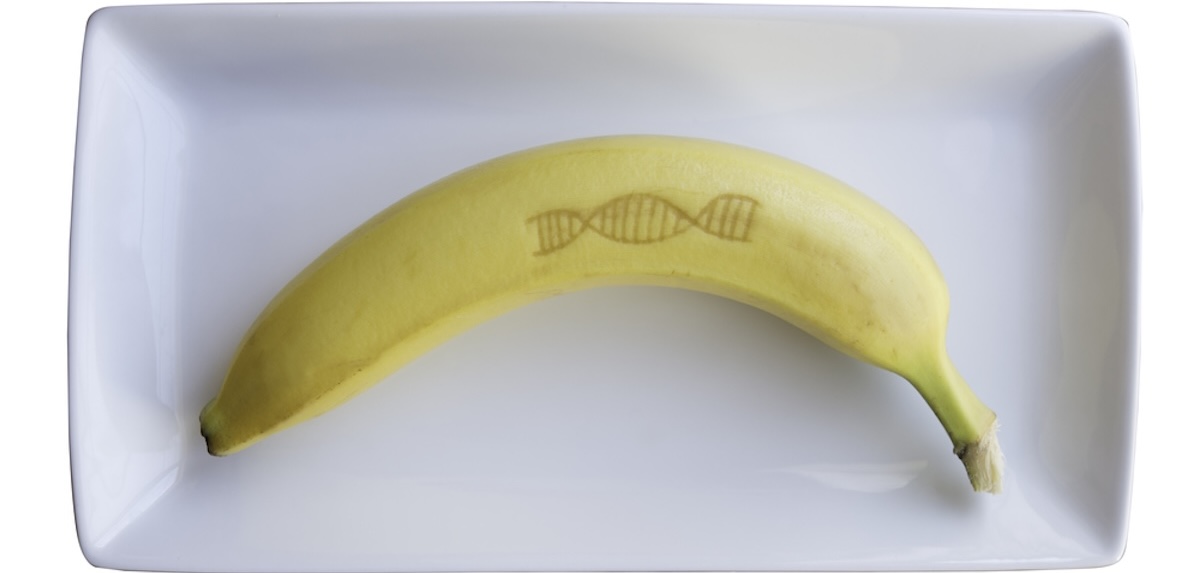
Tropic Biosciences UK Ltd has applied for permission to market in England a GM banana that has been gene-edited not to go brown when cut. The Department for Environment, Food and Rural Affairs (Defra) has granted a marketing notice confirming that the banana qualifies as “precision bred” and therefore as equivalent to what could arise naturally, under the Genetic Technology (Precision Breeding) Regulations 2025. Based on that claim of equivalence, it will escape risk assessment, traceability requirements and labelling.
Before it can be sold, it must still complete a food safety clearance by the Food Standards Agency (FSA).
The same non-browning variety has already received regulatory approval for import, sale, and consumption in 10 other countries, including Japan, Brazil and the Philippines. The fruit is already being grown in Latin America.
Below, Prof Michael Antoniou explains why the information provided by Tropic fails to demonstrate that the banana is “precision bred” and on the contrary, indicates that it may contain unintended changes that pose risks to health and the environment. He concludes that the banana’s “receipt of permission to enter the marketplace (pending assessment by the Food Standards Agency) has an unsound basis”.
---
Comments on the “Precision bred organism marketing notice (reference: PBM/26/MUAC/001)” and accompanying documents relating to Tropic Biosciences’ GM gene-edited non-browning banana
by Michael Antoniou, PhD, Emeritus Professor of Molecular Genetics and Toxicology, King’s College, London
10 October 2026
The following comments relate to Tropic Biosciences UK Ltd’s application to market their genetically modified (GM) gene-edited banana engineered to have a non-browning trait, and the subsequent granting of the marketing notice by the UK government’s Advisory Committee on Releases to the Environment (ACRE).
The overall conclusion is that the information provided by Tropic (“the applicant”) is
• insufficient to demonstrate that the banana is “precision bred” (that is, that it could have occurred naturally or through traditional breeding processes)
• insufficient to demonstrate that the risks to health and the environment posed by the banana are no greater than the risks posed by its conventionally bred counterparts
• indicative of additional risks to health and the environment beyond those posed by conventionally bred counterparts.
The following points demonstrate the reasoning for this conclusion.
1. Unintended effects of the gene editing and associated processes (tissue culture, GM transformation procedure) were not adequately looked for.
The applicant carried out whole genome sequencing (WGS) of the non-GM/gene-edited parent banana and of their selected gene-edited banana, but they did not align the two sequences to compare them, even though this would have been an easily achievable and logical next step and would have given vital information about the nature of the changes brought about by the gene editing and associated processes.
Instead, they compared the gene-edited banana against a public reference genome, DH-Pahang v2, using a computer prediction algorithm called the Breaking-Cas tool. This comparison unacceptably widens the range of variability, making it likely that the applicant and therefore ACRE will fail to notice important changes that could affect the risk profile of the gene-edited banana (for example, the production of novel toxins and allergens or altered levels of certain biologically active compounds). It must also be borne in mind that computer predictive algorithms are ineffective at identifying all process-induced off-target mutations.
The applicant’s search for off-target mutations (sites of DNA damage) was therefore inadequate, meaning that the banana may not have been, in fact, “precision bred”. The banana’s genome may contain off-target cut sites (where the gene-editing tool has made unintended double-strand DNA breaks) and large numbers of off-target mutations of varying types, all induced by the gene-editing and associated processes. These associated processes – tissue culture and the GM transformation procedure – are known to induce off-target mutations in their hundreds or thousands.[2] The tissue culture and GM transformation-induced mutations can range from single base unit alterations to large-scale chromosomal abnormalities.
A recent publication demonstrating the large-scale genomic instability from plant tissue culture looked at the rate of mutation accumulation, as well as the types of mutation, in cultured walnut tree cells. The researchers found “a >3,500% increase in mutation rates and exhibit whole chromosome duplications, large-scale deletions, somatic recombination events, and increased transposable element activity.” They concluded: “This work raises concerns about the genetic integrity of plants used for biotechnology approaches.”[3]
Interestingly, the highly mutagenic nature of tissue culture and the GM transformation procedure is confirmed by the very same paper (Tang et al, 2018[4]) that the applicant cites to assert that “off-target editing is highly unlikely to occur” and that “no off-target edits are considered to be present in the genome” of their banana, based on Tang and colleagues’ research on a completely different plant, rice.
As a general comment, it is not valid to use research on one type of gene-edited plant to form conclusions on a different type of gene-edited plant, as each gene editing event will yield different outcomes, depending on the specific genome of the plant and the gene editing tool and procedure used.
As a particular comment on Tang et al’s paper: despite its title, “A large-scale whole-genome sequencing analysis reveals highly specific genome editing by both Cas9 and Cpf1 (Cas12a) nucleases in rice”, the study found that while the CRISPR editing tools in themselves did not introduce many off-target mutations in the rice plants, many off-target mutations resulted from the associated processes that form an obligatory part of plant gene editing – namely tissue culture and the GM transformation procedure, as shown in Figure 2 of this publication. In the case of both Tang et al’s research and the gene-edited banana, the transformation procedure used was infection with a modified version of the soil bacterium Agrobacterium. In Tang et al’s research, the process-induced mutations they observed were in addition to the mutations caused by the activity of the gene-editing tool. Therefore, Tang et al’s study found that the Cas/gRNA gene editing process, taken as a whole, caused large numbers of off-target mutations far in excess of the cumulative level of genetic variation resulting from three rounds of natural reproduction. The applicant’s use of the Tang et al paper to justify their failure to look properly for off-target mutations is therefore highly inappropriate.
This is not to suggest that the number of mutations is all-important – it is what the mutations do that changes the risk profile. Such effects can only be established by further experiments – beginning with “omics” molecular profiling analyses:
• Whole genome sequencing (long-read) to reveal the full spectrum of DNA changes brought about by the gene editing and associated processes (such as tissue culture and GM transformation procedure)
• Transcriptomics, to reveal changes in global patterns of gene expression
• Proteomics, to reveal changes in the protein profile
• Metabolomics, to reveal changes in the metabolite profile.
These analyses, which are variously recommended to be performed on NGT products in numerous scientific papers,[5] can identify certain compositional changes and indicate potential risk factors such as unexpected toxicity or allergenicity. If identified, these risk factors need to be further investigated.
The above facts illustrate profound shortcomings in the ACRE approval process. It does not require useful information from the developer, even if they have the materials and tools to provide it.
In addition, it must be borne in mind that bananas are vegetatively propagated, by cloning. Vegetative propagation prevents the “breeding out” of genetic errors. In sexually reproducing crops, unintended mutations or off-target effects from genetic modification can potentially be removed through backcrossing and selective breeding. However, because commercial bananas are propagated vegetatively by cloning suckers, any genetic abnormalities introduced during the modification process will persist indefinitely in future generations – and will end up in the final marketed product. ACRE presents the clonal nature of the banana as an argument for its stability, but that stability can also apply to the off-target mutations and any accompanying risks.
2. There are problems and consequent risks from the intended edit.
The applicant’s banana had three sets of chromosomes (triploid). To achieve their aim, the applicant had to knockout the PPO1 gene, which encodes the enzyme whose activity is responsible for the banana’s browning when cut, on all three sets of chromosomes. As a result of their gene editing, they obtained three different types of indel (insertion or deletion of DNA bases) in the three targeted PPO1 alleles, causing a frameshift mutation in each of the three genes. Based on the molecular characterisation data provided by the applicant, these genes are not truly “knocked out” (deleted). This is because the three PPO1 genes were targeted for disruption in their first exon, leaving their promoters (“on” switches) intact. Thus, while the genes will not produce the PPO enzyme responsible for the browning, they will now still express novel mRNAs and mutant proteins. This is because all edits in the three PPO1 genes are frameshift mutations. Therefore, the edited banana will contain proteins that should not be there, with unknown health consequences. Arguably, the applicant should have deleted the gene, as this would not risk mutant gene expression and protein production.
3. The applicant and ACRE paid insufficient attention to the gene editing process.
The Genetic Technology (Precision Breeding) Regulations 2025 enable applicants to pay inadequate attention to the process of creating the gene-edited, allegedly “precision bred”, GM organism. This is a fundamental error, as it also avoids attention being paid to where things can go wrong. The applicant used a first generation CRISPR-Cas9 editing tool, which is known to be highly prone to off-target errors,[6] rather than more recent and more precise CRISPR-Cas tools, such as CRISPR-Cas12a[7] and CRISPR–Cas13.[8] They then used their computer algorithm, Breaking-Cas, to find off-targets, by looking at sites that differed from the target sequence by 2 or less base pairs.
However, evidence shows that differences in sequence between the guide RNA and a non-target site can be more than 2 base pairs, but the CRISPR-Cas editing tool can still mistakenly recognise it as a target and cut the DNA across its double strands.[9] Therefore the applicant set the wrong parameter for identifying off-target cut sites.
No computer predictive software is perfect. It is necessary to perform long-read whole genome sequence and look generically, in an unbiased way, for off-target genome-wide damage.
Conclusion
The applicant failed to look properly for unintended effects at two key levels. First, they did not take into account off-target genome-wide DNA damage, which is known to inevitably result from the gene editing and associated processes as a whole (tissue culture, GM transformation procedure). Second, they failed to acknowledge and analyse for production of novel mRNAs and mutant proteins that will be arising from the gene disruption (small indels in exon 1) that they carried out. Thus, the applicant and ACRE paid insufficient attention to the gene editing process, thereby missing potential off-target effects and consequent risks. As a result, based on the information provided by the applicant, it appears that this banana does not meet the criteria for a “precision bred” plant, and that its receipt of permission to enter the marketplace (pending assessment by the Food Standards Agency) has an unsound basis.
References
1. The documents are collected here: https://www.gov.uk/government/publications/precision-bred-organism-marketing-notice-reference-pbm26muac001
2. Latham JR et al (2006). The mutational consequences of plant transformation. J Biomed Biotechnol 2006(2): 25376. http://www.ncbi.nlm.nih.gov/pubmed/16883050 ; Wilson AK et al (2006). Transformation-induced mutations in transgenic plants: Analysis and biosafety implications. Biotechnol Genet Eng Rev 2006(23): 209–238. http://www.ncbi.nlm.nih.gov/pubmed/22530509
3. Davis MW et al (2026). Genome degradation in plant tissue culture. Proceedings of the National Academy of Sciences 123(17). e2530182123. https://www.pnas.org/doi/10.1073/pnas.2530182123
4. Tang X et al (2018). A large-scale whole-genome sequencing analysis reveals highly specific genome editing by both Cas9 and Cpf1 (Cas12a) nucleases in rice. Genome Biology 19:84. https://genomebiology.biomedcentral.com/articles/10.1186/s13059-018-1458-5
5. E.g. Chu P, Agapito-Tenfen SZ (2022). Unintended genomic outcomes in current and next generation GM techniques: A systematic review. Plants (Basel) 11(21). https://www.ncbi.nlm.nih.gov/pmc/articles/PMC9655061/ ; Koller F, Cieslak M (2023). A perspective from the EU: unintended genetic changes in plants caused by NGT – their relevance for a comprehensive molecular characterisation and risk assessment. Front Bioeng Biotechnol 11:1276226. doi: 10.3389/fbioe.2023.1276226 ; ANSES (2024). OPINION of the French Agency for Food, Environmental and Occupational Health & Safety on methods for assessing the health and environmental risks and socio-economic issues associated with plants obtained using certain new genomic techniques (NGTs). https://www.anses.fr/system/files/BIORISK2021SA0019EN.pdf ; Biswas S et al (2020). Investigation of CRISPR/Cas9-induced SD1 rice mutants highlights the importance of molecular characterization in plant molecular breeding. Journal of Genetics and Genomics. doi:10.1016/j.jgg.2020.04.004. https://www.sciencedirect.com/science/article/pii/S1673852720300916 ; Agapito-Tenfen SZ et al (2018). Revisiting risk governance of GM plants: The need to consider new and emerging gene-editing techniques. Front Plant Sci. Sec. Plant Biotechnology 9(2018). https://doi.org/10.3389/fpls.2018.01874 ; Mundorf J, Simon S (2026). Molecular verification requirements for Category 1 new genomic technique plants under Regulation (EU) 2026/1388. Preprints.org. https://www.preprints.org/frontend/manuscript/bbe275db3341b5c5c02e250adcc3fd9d/download_pub
6. Guo C et al (2023). Off-target effects in CRISPR/Cas9 gene editing. Front Bioeng Biotechnol. 11:1143157. doi: 10.3389/fbioe.2023.1143157. https://pmc.ncbi.nlm.nih.gov/articles/PMC10034092/
7. Genetic Engineering & Biotechnology News (2018). CRISPR-Cas12a more precise than CRISPR-Cas9. 3 Aug. https://www.genengnews.com/topics/genome-editing/crispr-cas12a-more-precise-than-crispr-cas9/
8. Wada N et al (2022). Expanding the plant genome editing toolbox with recently developed CRISPR–Cas systems. Plant Physiol. 188(4):1825–1837. doi: 10.1093/plphys/kiac027. https://pmc.ncbi.nlm.nih.gov/articles/PMC8968252/
9. Lin Y et al (2014). CRISPR/Cas9 systems have off-target activity with insertions or deletions between target DNA and guide RNA sequences. Nucleic Acids Res. 42(11):7473–7485. doi: 10.1093/nar/gku402. https://pmc.ncbi.nlm.nih.gov/articles/PMC4066799/ ; Jinek M et al (2012). A programmable dual-RNA–guided DNA endonuclease in adaptive bacterial immunity. SCIENCE 337(6096): 816-821. DOI: 10.1126/science.1225829. https://www.science.org/doi/10.1126/science.1225829
Image: Shutterstock (licensed purchase)