



Tragic incident begs questions about safety and ethics violations in the wider field of genetic engineering. Report: Claire Robinson and Jonathan Matthews
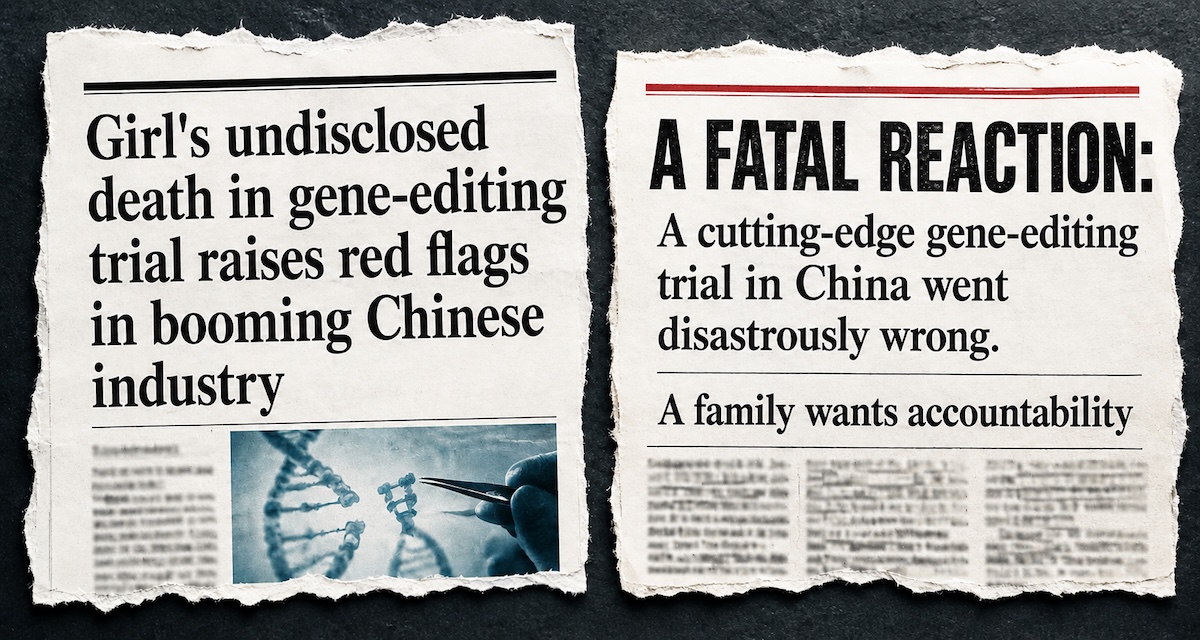
A six-year-old girl has died in a gene editing gene therapy trial in China that went wrong, the journal Science reports. Seven days after the girl's medical team infused trillions of viruses carrying the recipe for the gene editing tool – in this case a base editor – into her spinal fluid, she died of a severe immune reaction linked to the therapy.
Just to be clear, as long as patients are fully informed of the risks and give their explicit consent, we at GMWatch are not opposed to non-germline somatic gene therapy, which corrects genetic abnormalities that cause disease without affecting future generations or the wider environment. People across the world have benefited from such treatments for conditions including neuromuscular disorders, immune deficiencies, blindness, and cancer. We confine our opposition to germline (heritable) gene therapy, in which future generations are "treated" without their informed consent – and which is virtually certain to be used for eugenic purposes.
That said, while somatic gene therapy has had important successes, the field is afflicted by concerning issues that also bedevil the wider area of genetic engineering: hype, hubris, powerful conflicts of interest, very high costs – with one firm charging $3.5 million per 'dose' for treatment of the blood clotting disorder haemophilia B – and in some cases, safety issues that highlight the need for extreme care and rigour in the testing and use of these therapies.
Fatal immune reaction
In the Chinese trial, the girl's fatal immune reaction was to the massive dose of viruses used together with inadequate immune suppression, rather than base editing per se. This is confirmed by the comments in the Science article from James Wilson, who led the ill-fated gene therapy clinical trial at the Institute for Human Gene Therapy at the University of Pennsylvania, in which American teenager Jesse Gelsinger died from a massive immune reaction to the treatment for a genetic liver disorder. In that case too, a high dose of genetically altered virus carrying the corrective gene was the cause of the reaction.
Regarding the Chinese trial, Wilson said that animal trial results, in which monkeys given the therapy suffered liver damage, should have triggered additional studies at lower doses to determine the maximum tolerated dose – but those studies were not done.
According to official documents and accounts provided by the girl's parents, the hospital had allowed scientist Zilong Qiu's experimental treatment to proceed under a regulatory provision that does not require approval from national regulators. Her condition (a genetic abnormality that caused developmental delays) was not life-threatening. It was a clinical trial of one, funded in part by $860,000 the parents had scraped together from their own savings and from relatives. Two days after the child died, the hospital's ethics board convened an emergency meeting and concluded her death was "definitely related" to the treatment.
In its article, Science reviewed the initial hype around the therapy and contrasted it with what happened afterwards: "Although news that base editing saved 'Baby KJ' would soon rocket around the world – Science named the feat one of the runners-up for its 2025 Breakthrough of the Year –the story of what happened at Xinhua Hospital has remained hidden. An entry for the study posted to ClinicalTrials.gov has not been updated for more than a year. And when Qiu and his colleagues published proof-of-concept animal studies related to the trial in Nature early this year, they stripped the paper of references to the family and its financial contributions, noting only that 'bridging the gap between preclinical research and clinical translation remains a significant challenge.'"
Hubris
In GMWatch's view, this is a tragic story of scientific hubris, greed, corruption, and violation of ethics. As the Science article says, "Seven experts in fields including genetics, virology, and bioethics who reviewed details of the Nature study and the clinical trial for Science and Retraction Watch expressed concern that Qiu and his team downplayed the trial's risks in describing them to the parents, overlooked safety signals in animal studies, and proceeded even though success was unlikely. 'This shouldn’t have gone to trial,' says Steven Gray of the University of Texas Southwestern Medical Center, who develops viruses for gene therapy."
We would add that it is not ethically acceptable for a scientist to effectively extort $860,000 from desperate parents in exchange for an experimental treatment for their child that has not been shown to be safe in even the most basic of tests. What adds to the concern is that Qui and his team are said to be "well-established scientists in one of China's most prestigious universities". And global health expert Yanzhong Huang told CNN that although one would hope that a case like this, that was "full of mistakes, loopholes, and irregularities", was a one-off, in the drive for China to become a biotech superpower, "this may potentially be the tip of the iceberg".
Lessons from the Gelsinger case
The Chinese case is reminiscent of the failings in the earlier Jesse Gelsinger trial in the US. After Gelsinger's death, a lawyer retained by his family said the teen was not told that other patients had experienced serious side effects from the therapy, or that three monkeys had died of a clotting disorder and severe liver inflammation after being injected. The US FDA suspended the trial, citing a failure to train staff adequately, develop basic operating procedures and obtain informed consent. In addition, the FDA found "deviations" from an agreed protocol. One FDA official revealed that when Gelsinger underwent the therapy, his blood ammonia level was more than 50% above the maximum permissible level set in the protocol.
As a result of all this, the US government banned James Wilson from working on FDA-regulated human clinical trials for five years and shut down all clinical trials at the Institute for Human Gene Therapy. Wilson spent the next decade searching for safer gene therapies.
In contrast, the only consequence to date of the incident in China is that the hospital paid a modest fine to a local health authority. Qiu was not publicly sanctioned.
In this same 'Wild West of genetics' spirit, just a few years ago, also in China, the scientist He Jiankui produced gene-edited babies in unauthorised secret experiments, which were met with almost global condemnation, and which seem to have gone badly awry due to technical problems with the gene editing. At that time, faced with a global outcry, the Chinese authorities appeared to take the ethical violations more seriously. A court in Shenzhen said He and two colleagues had acted "in the pursuit of personal fame and gain" and had seriously "disrupted medical order". He Jiankui was fired from his university, heavily fined and jailed for three years. Ironically, among those who condemned He Jiainkui's actions was Zilong Qiu.
Not just China
The way that the He Jankui case has typically been framed paints him as a lone "rogue" scientist operating in China's particularly lax regulatory environment. But He Jiankui received his higher education and scientific training in the United States. And his American doctoral supervisor cooperated with him on the gene-edited baby research and was even named as the senior author on a paper about the work that He submitted to the journal Nature shortly before news of the experiment leaked globally. It further emerged that a number of other prominent American scientists had also known about He Jankui's dangerous experiment long before it became public but failed to report it. Among these was a Nobel laureate, who apparently objected to what He was doing but still remained an adviser to He's biotech firm.
More broadly, the molecular biologist Dr David King points to how institutional reports on the ethics of germline gene editing from major bodies in the UK and US helped create the permissive environment in which He Jiankui acted. By normalising the idea that engineering human embryos for reproduction could be ethically acceptable in the future, rather than drawing a firm uncompromising red line, these reports provided, if not a roadmap, a scientific trajectory for He Jiankui. "While He Jiankui is the cartoon villain of this piece," King wrote, "the stage was set for him by the US National Academy of Science and the Nuffield Council on 'Bioethics', whose reports Jiankui used in ethical justification of his actions."
But by blaming what occurred on a maverick "outsider", the genetic engineering establishment successfully contained the fallout. This in turn allowed the broader biotech industry to protect its reputation and continue pursuing risky research and lucrative commercial applications of CRISPR technology with minimal regulatory backlash.
Not just human genetics
This is far from the only instance of recent ethical abuses in genetic engineering not being confined to China. Nor have they been confined to the field of human genetics. Let's not forget that in relation to the COVID-19 pandemic that killed millions and cost trillions:
* The virus that causes COVID-19 could plausibly have emerged from genetic engineering experiments in a lab that was situated in China but which again had Western enablers. For instance, the dangerous research going on in Wuhan was partly funded by Dr Fauci's US National Institute of Allergy and Infectious Diseases (NIAID), via Peter Daszak's EcoHealth Alliance.
* Highly influential Danish, British, and American virologists conspired to publicly deny the possibility of a manipulated virus or a lab leak origin, even though we now know that privately they had serious doubts about what they were publicly maintaining – in effect, lying in a published paper to protect their own interests as well as the public image of genetic engineering.
* Fauci, a long-time supporter of gain-of-function research in which viruses are engineered to be more transmissible, virulent, or lethal, is now pleading the fifth amendment (the right to stay silent in order not to incriminate oneself) rather than answer Senator Rand Paul's questions about his handling of the COVID pandemic and accusations that he was part of what Princeton professor Zeynep Tufekci has characterised as "a conspiracy to cover up and deny the possibility it may well be a lab mishap, orchestrated from the highest levels of the scientific establishment and a self-serving group of scientists who deliberately misled the public."
* Recently released emails show that the EcoHealth Alliance's Peter Daszak tutored the Wuhan Institute of Virology's Shi Zhengli in stonewalling questions about the bat coronaviruses that the Institute had been working with, including around this important question: "How did a bat virus that barely binds to its own host's receptors naturally evolve into a virus better optimized for human receptors? " Daszak, it may be remembered, was a member of the WHO mission to China in early 2021, which as part of its supposedly independent investigation into the origins of the pandemic visited the WIV – the institute that Daszak's organisation had funded (with monies from Fauci's NIAID) and collaborated with in research on SARS-related bat coronaviruses in low biosafety (BSL-2) labs.
Agricultural genetic engineering
In the area of agricultural genetic engineering too, the industry and its allied scientists and compliant governments have repeatedly lied to and misled the public. That includes making false and misleading claims about the safety and precision of new gene-editing techniques to justify deregulating them – removing from gene-edited crops and foods the safety checks, traceability and labelling that have traditionally been applied to all GMOs. Many of those making the claims have strong conflicts of interest, as they stand to benefit from a climate of lax regulation. As a result of their systematic work to hide new gene-edited plants via an absence of labelling beyond the seed, if something goes wrong, such as a toxic or allergic reaction to a gene-edited food ingredient or an environmental problem, it's less likely that we shall be able to trace the cause.
Not content with raising the risk profile of the foods we eat, the EU Commission has subsequently set in motion a deregulation of GM micro-organisms, to encompass bacteria, fungi (including yeasts), and viruses. A recent paper warns that GM microbes pose a wide spectrum of risks, including horizontal gene transfer to native species, the possible disruption of vital human microbiomes (gut, oral, and infant), and expanding a microbe's range of hosts or ecological niches. GM microbes may support the emergence of "super bugs" – one strong possibility is inadvertently making a benign bacterium into a pathogen – or, in soil, destabilise carbon sequestration cycles, impacting climate resilience. Engineered microbial enzymes in the food supply may also act as environmental drivers of autoimmunity.
The pressure is also on for GM animals to follow microorganisms down the path of relaxed regulation, with the worst risks probably being borne by the animals themselves.
The deregulation of GM gene-edited crops, microbes and animals has been marked by a trail of hubris, corruption, and top-down deceptions that is disturbingly similar to key features of the "clinical trial gone wrong", the CRISPR babies, and the COVID cover-ups. In almost all these cases, the risks of premature experimentation with disruptive new technologies are imposed on the often unconsenting public, while powerful vested interests stand to profit and those calling for caution are sidelined or vilified.
It is time for our policy makers to claim back the power that they have given to the biotech sector, which, based on its historical and current record, cannot be trusted to use it wisely and in the public interest.