



New gene editing technique can easily circumvent risk assessment, thanks to the EU's lax new rule, says Swiss GMO-free organisation SAG
A recent publication by the Innovative Genomics Institute, founded by CRISPR co-developer Jennifer Doudna, reveals a new dimension of next-generation gene editing (NGT). When skilfully controlled, even the smallest changes to the genome can have a particularly powerful effect and drastically alter plants. This strategy is known as hypermorphing – that is, the targeted exaggeration of biological traits – and is a cause for particular concern, the Swiss GMO-free organisation SAG points out.
This is because under a new EU regulation, NGT plants with fewer than 20 genetic modifications will in future be authorised without a risk assessment – an arbitrarily set threshold that by no means protects against risks. Strategies such as hypermorphing can easily circumvent this threshold whilst still bringing about drastic and potentially risky changes.
As few interventions as possible – maximum impact
The strategy behind this is ingenious: using CRISPR/Cas, numerous DNA segments that act as switches for gene activity are first modified. The researchers then select those minimal mutations that bring about the greatest possible change in a specific plant trait. In this way, gene activity can be controlled particularly effectively with just a few interventions.
It is precisely this minimal number of modifications that is politically controversial. Under the new EU regulation, NGT plants with up to 20 genetic modifications will in future be placed on the market without mandatory risk assessment and without labelling. However, the new publication clearly shows that it is not the number of modifications that determines the risk, but their effect.
Entirely new biological properties – and risks
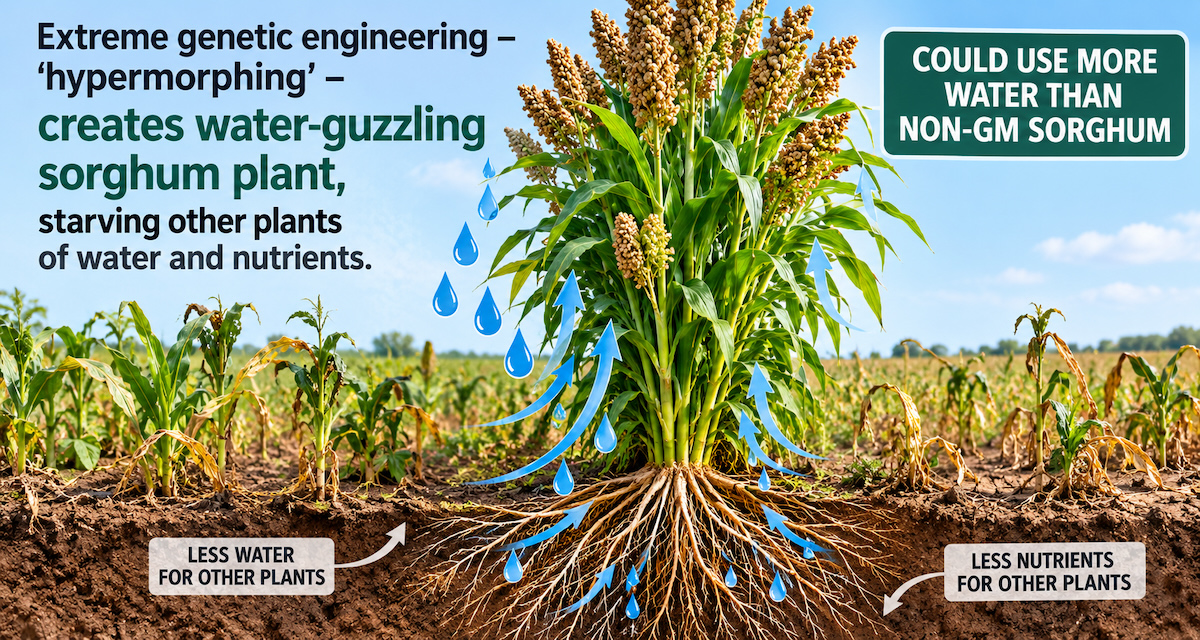
Using sorghum as an example, the researchers demonstrate how ‘hypermorphing’ has enabled a massive increase in photosynthetic performance – by more than 30-fold, according to the publication. Such characteristics have not previously existed either in nature or in conventional breeding. Even older genetic engineering techniques involving the insertion of transgenes have not been able to achieve such extreme changes to date.
This results in plants with entirely new biological characteristics – and, consequently, risks to ecosystems that are difficult to assess. Plants with significantly increased photosynthesis, for example, could spread invasively. Excessive consumption of water and soil resources as a result of uncontrolled growth is also a possibility.
An arbitrary threshold does not protect against risks
The study thus highlights a fundamental problem with the new EU regulation on NGT plants: the threshold of ‘20 genetic modifications’ has no scientific basis and offers no protection against risks. Even a single, precisely targeted mutation can have far-reaching effects on plants and the environment. GMWatch adds that it can also make a food toxic or allergenic.
No matter how hard policies driven by economic interests try to gloss over such inconvenient facts, the latest research findings underline the urgent need for independent risk assessment and strict regulation. Without thorough scrutiny, crops could be released in future whose impact on the environment and agriculture is virtually impossible to predict.
If you are in Switzerland, sign the petition ‘No EU GMOs on our plates!’ now, addressed to the Federal Council and Parliament, calling for strict regulation of new genetic engineering to protect Swiss agriculture from the risks posed by GMOs!
Source of commentary: SAG, translated into English using Deepl
More on hypermorphing, from Testbiotech
Note: An earlier version of this article followed Deepl in translating the German word "Hirse", in SAG's article, as "millet". "Hirse" can mean "millet or "sorghum". However, as the Doudna team's publication names sorghum as the example plant that was hypermorphed, we have corrected "millet" to "sorghum".