



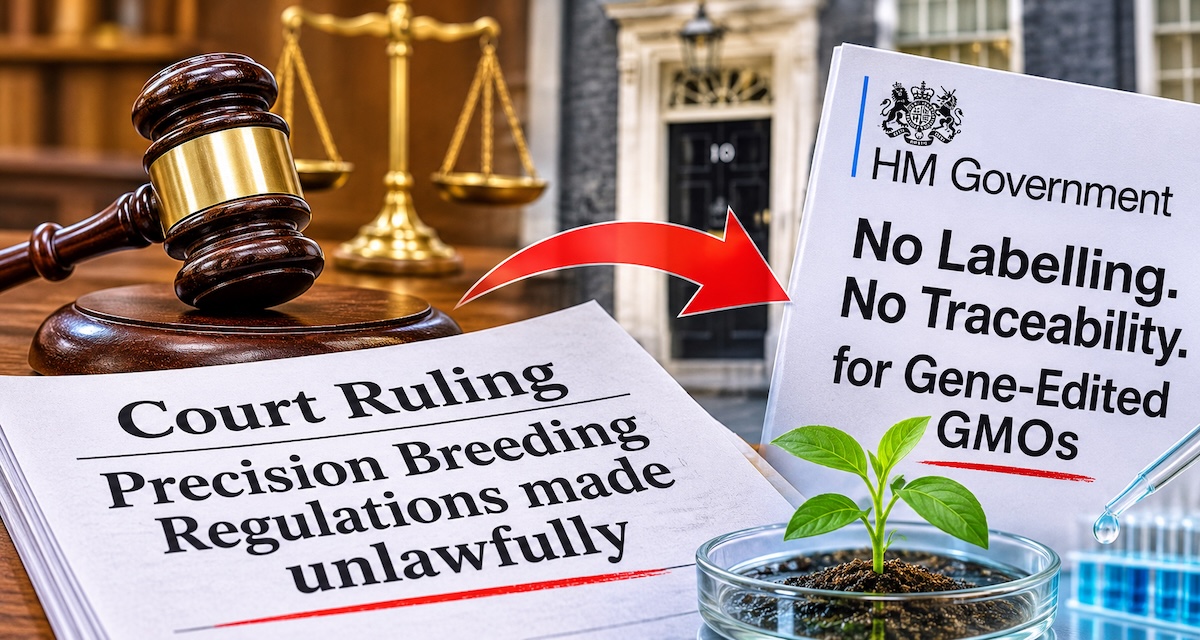
 Only weeks after a court ruled that England’s Precision Breeding Regulations had been made unlawfully, government decided to keep its policy of not requiring labelling and traceability for gene-edited GMOs. Report: Claire Robinson
Court documents obtained by GMWatch reveal how Defra rushed a newly appointed minister into making a decision behind closed doors to maintain England’s controversial gene-editing regime – soon after the High Court ruled that the Regulations had been made unlawfully. Defra’s actions have prompted claimants Beyond GM et al to bring a second judicial review of the Regulations.
Mere weeks after the High Court ruled that England’s Genetic Technology (Precision Breeding) Regulations 2025 had been made unlawfully, the government took a “discrete decision” to maintain its existing policy of not requiring mandatory labelling and traceability for gene-edited “precision bred” organisms in food and agricultural supply chains.
The decision was taken by newly appointed farming minister Stephen Morgan, who had been in office for just 11 days. According to the court papers, it followed a short meeting with Defra officials, reported as lasting around 15 minutes.
Two days later, the government told the High Court that the minister had reconsidered the issue and decided to maintain the existing policy. It used that decision to argue that quashing the Regulations would serve little purpose.
But did the government genuinely address the failures identified by the court, or did it simply engineer another way to arrive at the same conclusion?
Documents obtained exclusively by GMWatch from the Administrative Court Office shed new light on that question.
They include the Statement of Facts and Grounds filed by Beyond GM and its co-claimants in their second judicial review and the government's formal response. GMWatch is publishing both documents alongside this article.
Together, they reveal a dispute not just about the government’s decision to maintain its GMO deregulation policy, but about how that decision was made, whose interests were considered, and whether ministers properly responded to the High Court’s findings.
The regulations are unlawful
On 4 June 2026, Beyond GM and its co-claimants – two organic farmers and an ethical consumer – won a landmark judicial review challenging England’s new precision-breeding regulatory regime.
The High Court found that the minister responsible for making the Regulations, Farming Minister Daniel Zeichner, had been wrongly advised about his powers under the Genetic Technology (Precision Breeding) Act 2023.
He believed that the Act allowed him to require labelling of seeds, but had not understood that he had powers to introduce wider requirements for labelling and supply chain traceability of gene-edited organisms used in food and feed.
In fact, the Act gave ministers broader powers to mandate traceability and labelling throughout the supply chain.
The court found that Zeichner’s misunderstanding had unlawfully restricted the options he considered and the enquiries he made. Had he been correctly advised, it said, there was a real possibility that he would have considered materially different options or investigated more fully the practical consequences of not mandating labelling and traceability and may even have made materially different regulatory decisions.
The High Court ruling established that the original decision-making process was unlawful. The question of what should happen to the Regulations was left for a subsequent remedy hearing and both sides were invited to submit their recommendations to the court.
In the period between that judgment and the court’s consideration of a remedy, Defra took the decision now at the centre of the second judicial review.
A false deadline
The timeline revealed in the court papers is remarkable.
Two weeks after the High Court ruling, on 18 June, Defra civil servants submitted a briefing containing information and formal advice on the Regulations and the judicial review and requested a decision from the minister on next steps.
On 23 June – 19 days after the ruling – Morgan decided to maintain the existing policy.
On 25 June, Defra submitted its remedy arguments, including evidence of Morgan’s decision, to the court explaining why, in its view, the Regulations should not be quashed.
According to Beyond GM’s court submissions, the decision had been presented to Morgan as urgent. An email to his private secretary stated: “Urgent – a decision is required urgently in order to meet court deadlines.”
Beyond GM says the court’s 25 June deadline was for the parties’ remedy submissions; it did not require Stephen Morgan to make a fresh policy decision. Its claim records that officials wanted his decision before drafting those submissions and that the ‘urgency’ therefore arose from the Government’s timetable for making its case against quashing the Regulations.
In addition, it argues that Morgan was pressed to make a complex decision on an inadequate briefing, after only 11 days in post, so that the Government could rely on it in its arguments against quashing the Regulations. It says the urgency, the limited information and Morgan’s unfamiliarity with the issues need to be considered together.
Told the High Court misunderstood
A troubling allegation concerns how the original High Court judgment was presented to Morgan. Referring to the briefing given to Morgan, Defra says the new minister was formally instructed to accept the High Court’s judgment and reconsider labelling with an open mind.
Beyond GM’s claim points to a passage in the ministerial briefing that said, “The High Court has not accepted our understanding” of what Minister Zeichner knew. The claimants argue that this sat uneasily with the instruction that Morgan should accept the judgment in full and risked undermining the open-minded reconsideration Defra describes.
Defra also told Morgan that broader food-labelling powers existed under the Food Safety Act 1990. The High Court’s judgment, however, concerned the wider powers under the Genetic Technology (Precision Breeding) Act 2023 to secure traceability of food and feed from precision-bred organisms across the supply chain.
The claimants argue that presenting the Food Safety Act as an alternative route to labelling was an inadequate and legally questionable alternative to the specific powers granted in the Genetic Technology Act.
Their overarching contention is that, after an adverse court judgment, a minister reconsidering the policy needed a clear account of both what the court found and the full range of relevant powers. They argue that Morgan was not given that clear account.
What did the Minister know?
Defra maintains that Morgan was adequately briefed, having received, amongst other papers, a copy of the judgment, a briefing pack and an Annex, which it describes as a “fair and accurate summary” of the organic sector’s concerns.
Beyond GM’s claim challenges this, arguing that the briefing was inadequate because it omitted key documents, such as earlier impact assessments and the De Minimis Assessment that accompanied the Regulations, and downplayed matters the court had already identified as relevant.
These included the practical problems facing organic farmers and food businesses who must keep gene-edited organisms out of their supply chains, the potential additional costs for the organic sector and the implications for trade with the EU and the devolved nations.
For the organic sector, as the original court judgment noted, maintaining supply chain integrity is not a minor concern.
Morgan also did not receive information on the views of ethical consumers, trade impacts or how “established methods” for keeping supply chains separate would work in practice.
Beyond GM’s claim also highlights an assertion, made by advisors and recorded in the ministerial meeting, that introducing labelling for PBO food and feed would increase divergence from EU regulations.
We put this point to Pat Thomas of Beyond GM. While Thomas is not able to comment on the particulars of the second judicial review, she maintains: “The exclusion of all GMOs and the ability to verify supply chain integrity is a fundamental legal requirement of organic regulations in the EU and worldwide. This does not change simply because England has decided to give these new GMOs a different name.”
Defra’s deregulatory approach, as was argued in the first case, leaves those who cannot or do not wish to use gene-edited organisms bearing the heavy burden of avoiding them, without providing adequate means to do so.
Our own reading of the case files suggests that simply giving a minister some documents, or a summary of stakeholder concerns, is not the same as ensuring that the relevant evidence was fairly presented, fully understood or properly considered.
To consult or not to consult…
A central dispute in the second judicial review concerns consultation.
The government argues that consultation had already taken place before the 2025 Regulations were introduced. It describes Morgan’s reconsideration as a “discrete decision” taken in response to the High Court judgment, rather than a fresh exercise in designing the regulatory regime. For that reason, further consultation was not necessary.
But further scrutiny of the documents reveals a contradiction: Defra maintains that it did not consult anyone on Morgan’s decision. But its documents acknowledge seeking views from biotech industry stakeholders about the possible negative consequences of quashing the Regulations.
According to the government, this was a separate exercise, undertaken to gather evidence for the court about the appropriate remedy, rather than to inform the minister’s policy decision.
Beyond GM challenges this and raises questions about the apparent imbalance in whose interests were considered important enough to interrogate.
Our analysis, based on the papers we’ve seen, is that the potential consequences of quashing the Regulations for businesses developing gene-edited products were treated as priority matters requiring evidence. The consequences of keeping those Regulations unchanged – for organic farmers, non-GM businesses and consumers – were deprioritised and not subjected to equivalent scrutiny.
A closed-door decision
The court papers also expose a disagreement about whether the government was required to make Morgan’s decision public.
Beyond GM and its co-claimants say they first learned of the decision when Defra relied on it in submissions to the court.
The government argues that Morgan made a specific ministerial decision, not a new general policy that it was legally required to publish.
The second judicial review claim, however, points to the official record of the ministerial meeting, in which Morgan and officials referred to maintaining the “current policy” of not requiring labelling.
The claimants argue that the policy decision directly affects third parties, including farmers and businesses who were not involved in the litigation and that it should have been made public.
The wider question that runs through the documents is: how should a government act and how should it respond when a court has found that a major regulatory decision affecting farmers, businesses and consumers was made unlawfully?
Keeping the regime going
The unresolved litigation creates uncertainty about the future of the regulatory system and the products moving through it.
The judgment of unlawfulness did not automatically quash the Regulations and the time lag between the June 2026 judgment and the remedy hearing has been exploited by the government to continue to operationalise England's precision-breeding regime.
Eight experimental field trial notices and five marketing notices have been published since the original judgment, even though the court has yet to determine the appropriate remedy.
The Food Standards Agency is now assessing three applications for permission to market precision bred wheat, strawberries and bananas.
Defra has argued against quashing the Regulations, while Beyond GM and its co-claimants maintain that the unlawful decision-making process cannot simply be left without an effective remedy.
The claimants are asking the court to quash the Regulations in the first case and to find Morgan’s subsequent decision unlawful in the second. These arguments will be considered at a hearing scheduled for March 2027.
Another test of Defra’s accountability
The first judicial review established that the decision to introduce the Regulations had been made unlawfully because the minister misunderstood his powers and failed to make proper enquiries.
The second asks whether the government genuinely corrected those failures with its “discrete decision” – or simply repeated them in an effort to reach the same conclusion.
The ongoing dispute raises a fundamental issue of public accountability: when a court finds that a government has failed to investigate the consequences of its decisions, can that government lawfully reach the same conclusion without undertaking the further enquiries that it failed to make in the first place?
That is the profound question at the heart of the second judicial review of Defra’s Genetic Technology Regulations.
- The remedy hearing for JR1 and the JR2 case will now be heard together at the High Court on 17–18 March 2027.
- The court documents obtained by GMWatch – the claimants’ Statement of Facts and Grounds and Defra’s Summary Grounds of Resistance – are published alongside this article. We will publish further documents as they come into the public domain.
You can contribute to Beyond GM's fundraiser for their court cases on the Crowdjustice website.