



And the tactics deployed to try to shatter the budding bipartisan alliance among its critics. Report: Jonathan Matthews
Bayer-Monsanto’s fortunes were transformed this year when – despite its years of intense lobbying for legal immunity for Roundup suffering setback after setback in the courts and in state legislatures and Congress – the Supreme Court ruled 7-2 in the company’s favour. Here we look into the critical role played by the Trump White House in engineering that victory and how the administration has dealt with the fallout.
Unwavering political support
There is an obvious contrast between how the Biden administration urged the Supreme Court to reject Bayer’s appeals – arguing that EPA approval of a label does not shield a company from state-level lawsuit payouts – and how the Trump administration aggressively intervened on Bayer’s behalf.
And Trump’s Justice Department didn’t just ask the Court to take the case; once it did, the Solicitor General’s office filed its own brief and presented oral arguments alongside Bayer’s legal team, successfully securing the landmark ruling that now shields the world’s leading producer of GMO seeds and pesticides from failure-to-warn lawsuits.
Trump’s executive order: the true catalyst
Victory didn’t rely solely on this carefully coordinated strategy of unwavering political support for Bayer. The true catalyst was a Trump executive order framing glyphosate-based herbicides – and, significantly, the elemental phosphorus that glyphosate is derived from – as crucial for ‘National Defense’. By declaring these chemicals vital to national security and agricultural survival, the order mandated immediate protections for the supply chain and an aggressive push to boost domestic production.
The timing was meticulously choreographed. Dropping just one week before Bayer’s Supreme Court deadline, the order handed Bayer’s legal team the ultimate weapon. They immediately leveraged Trump’s national security declaration to demand federal preemption over state lawsuits, arguing that legal immunity was a matter of national survival.
Weapons of war
William Boyd, Professor of Law at UCLA School of Law, is among many who have expressed astonishment at Trump’s executive order: “In the context of wartime and other similar emergencies, one can understand why such expansive liability protection might be necessary. But as a way to placate and protect a German multinational chemical company, this is beyond extreme”.
It would be easy to attribute this unprecedented use of wartime powers to bail out a foreign conglomerate to Bayer’s $1 million payout to Trump’s inauguration, which not a single other German corporation felt it necessary to contribute to. There are also the 29 key administration officials with ties to the company’s lobbying or legal network, and the more than 30 senior officials at lobby firms retained by Bayer who have direct ties to Trump.
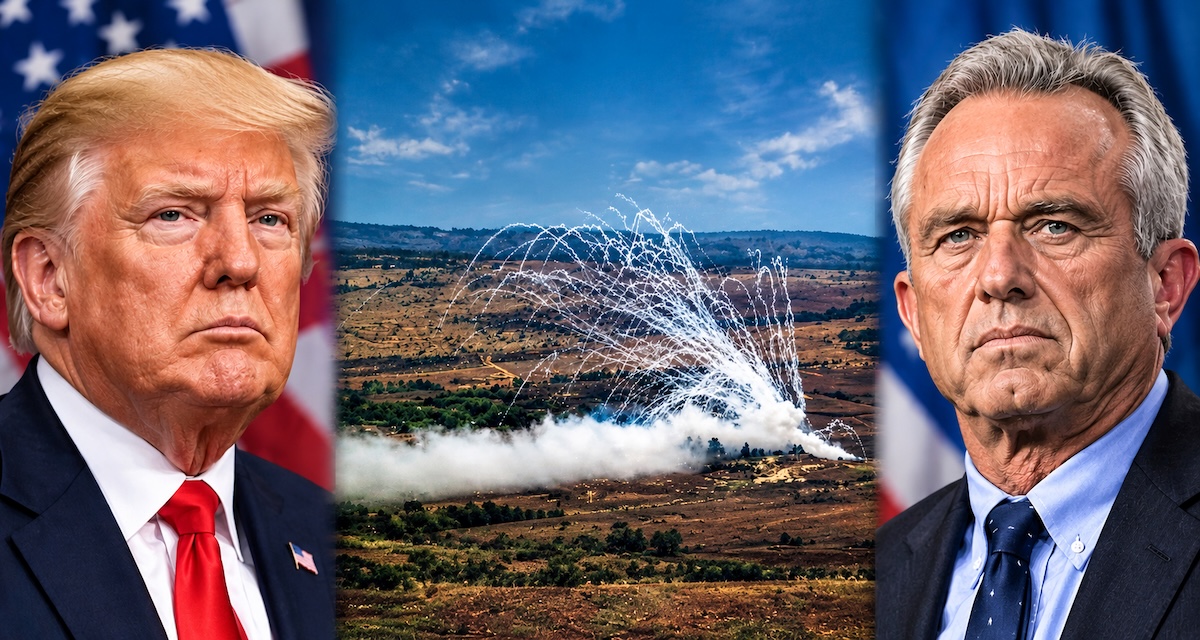
But an incisive analysis we published by Dr Michael Hansen, which was then followed by others in the New York Times and TIME magazine, contended that Bayer had also exploited a different point of leverage – the need to ensure that the US and Israeli militaries did not lose the sole supplier of a critical weapon of war: elemental (white) phosphorus. According to the New York Times, “two people with direct knowledge of the administration’s deliberations” had confirmed that concerns about the availability of white phosphorus munitions played “a significant role” in Trump’s “move to deem Bayer’s operations a national security priority”.
Weapons deployed
Even before we could publish Dr Hansen’s analysis, Trump and Israel had launched major attacks on Iran, and Israel was making repeated use of the Bayer-sourced white phosphorus that the US supplies it with in attacks on residential areas of Lebanon, in violation of international law.
In an act of ecocide, Israel also deployed another chemical weapon over large agricultural areas in southern Lebanon, just as it has in Syria and Gaza: glyphosate. All of which triggered protests, including a call for a total boycott of Bayer’s products, and even a missile attack on the Israeli chemical complex of ICL Group – Bayer’s some-time partner in white phosphorus production.
Weapons contracted
Bayer-Monsanto has long managed to obscure its arms production role behind supply chain intermediaries, most notably ICL Group which, with a US base in St Louis, Missouri, has long operated as a convenient cut-out between Bayer and the military. But Bayer CropScience is not just Bayer’s agricultural division but a dual-use chemical juggernaut that sits at the very top of the US military’s white phosphorus supply chain – a fact that has been further underlined by a recent multi-million-dollar arms deal. The contract commits Bayer to supplying as much white phosphorus as required by Pine Bluff Arsenal – the US army’s key production centre for its Chemical Corps – where Bayer’s highly reactive and toxic chemical gets loaded into artillery shells and other munitions.
Some have shied away from acknowledging the role white phosphorus munitions played in Trump’s executive order, concerned that it might distract from the glyphosate issue. But people deserve to know that part of why Bayer and glyphosate are being protected so fiercely by the Trump White House is to enable the US and Israel to continue to carry out humanitarian atrocities with a weapon that can inflict some of the most horrendous injuries known in war.
MAHA betrayed
Meanwhile, the storm of protest over the Trump administration’s ironclad support for Bayer and blanket protection of glyphosate has triggered another kind of war – a culture war. At the root of this is the massive sense of betrayal among many of the supporters of the Make America Healthy Again (MAHA) movement, founded by Robert F Kennedy Jr, a well-known crusader against toxic chemicals in general and glyphosate in particular. MAHA is widely credited with helping get Trump elected after Kennedy endorsed him in 2024 and Trump promised that he and Kennedy would “ensure that everybody will be protected from harmful chemicals, pollutants, pesticides”.
Kennedy himself pledged that if he were chosen to serve in a second Trump administration, he would “ban the worst agricultural chemicals that are already prohibited in other countries”. But despite more than a quarter of all agricultural pesticides sprayed in the US consisting of substances that European regulators have deemed too dangerous to allow, not a single pesticide of any description has been proactively banned by the Trump administration. Instead, the Environmental Protection Agency (EPA) under Lee Zeldin – a politician with a well-documented track record of advocating for sweeping deregulation – has focused on expanding pesticide availability and rolling back safety rules and restrictions.
Indeed, rather than banning pesticides long outlawed abroad, Trump’s EPA has fought to keep them on the US market. Among the most notorious is atrazine, a cancer-linked hormone-disrupting pesticide banned in 60 countries and shown to contaminate a quarter of US rivers, including many waterways used for drinking water. Another is paraquat, banned in over 70 countries – including China, India, Brazil, and the entire European Union – due to its extreme toxicity and links to Parkinson’s disease.
The Trump administration has also expanded pesticide use by rapidly greenlighting five “forever chemical” (PFAS) pesticides for use on American food crops, as well as restoring the use of the highly drift-prone weedkiller sprayed on GMO crops, dicamba – known for damaging crops, trees, and wild and garden plants, on a scale never seen before in US agricultural history.
None of these developments are surprising given that Trump has stacked the top officials in the EPA’s pesticide and chemical safety offices with former industry lobbyists, executives, and attorneys who have spent their careers attacking health and environmental protections.
Meanwhile, the EPA’s independent Office of Research and Development (ORD), which provided critical expertise about how to protect human health and the environment from the impact of toxic chemicals, has been dissolved and hundreds of its scientific staff fired. “Much of what keeps America’s air, water, and food safe relies on ORD’s research and expertise,” according to former EPA and ORD scientists.
United front
The sheer scale of the MAHA betrayal has contributed to an emerging alliance typified by the People vs Poison rally that took place outside the Supreme Court on the day it met to hear Bayer’s glyphosate appeal. The rally saw a remarkable convergence of MAHA influencers and grassroots leaders, with mainstream environmental groups, bipartisan lawmakers, and independent farmers turning the steps of the Supreme Court into a unified front against corporate legal immunity.
This potentially powerful alliance poses a direct political threat to the Trump administration, given the US mid-term elections on November 4th. The administration has consequently been trying various stratagems to defuse the intense backlash.
Trying to win back disillusioned MAHA voters
Tactics to quell the furious reaction include deploying RFK Jr for high-profile interviews; rolling out the red carpet in the West Wing for MAHA influencers, who after meeting Trump in the Oval Office departed with gold Trump challenge coins and “Trump 28” hats; holding a decidedly dubious Walmart-financed MAHA summit; and the issuing of a presidential executive order on regenerative agriculture.
On closer inspection that order – issued just hours after the Supreme Court had handed Bayer its massive victory at the administration’s urging – turned out to be completely toothless, lacking any regulatory bite and containing no new money. And critics quickly concluded that rather than enacting a true transition toward toxic-free food systems, it was merely a PR shield to distract MAHA voters from the simultaneous judicial protections given to pesticide manufacturers.
After that ploy proved a dud, Zeldin’s EPA announced it would team up with Kennedy’s Department of Health and Human Services (HHS) in an expanded review of glyphosate’s safety. But critics are deeply sceptical of the sincerity of the EPA’s announcement, with one long-time observer of US pesticide regulation dismissing it as “a bunch of smoke and mirrors”. That scepticism comes partly from the improbability of Zeldin’s industry-friendly EPA, and an administration that has expended so much political capital aggressively defending Bayer’s interests, suddenly changing course. But it also comes from Kennedy’s evident inability to deliver.
Kennedy also proves a dud
When RFK Jr was challenged over Trump’s executive order promoting the production of glyphosate and elemental (white) phosphorus for “national security and defense reasons”, he backed it. Kennedy told Joe Rogan that 99% of the glyphosate used in the US came from China and that the Pentagon called this dependency an “extreme national security vulnerability”. But this isn’t true. Bayer-Monsanto’s domestic US glyphosate production accounts for around 60% of the glyphosate sold in the US, meaning imports from all countries combined (not just China) make up a minority share of the US supply – not 99%!
Kennedy apologists have sought to explain away his defence of Trump’s order – protecting the chemical Kennedy himself once called a threat to public health – as “Bobby taking one for the team” on an issue beyond his purview as HHS Secretary. But that won’t wash with the two reports on childhood chronic illness issued by the MAHA Commission – a body established by Trump as the primary vehicle for advancing Kennedy’s public health platform.
The Commission’s initial report did raise serious concerns about the impacts of “pesticides, herbicides and insecticides” on health, and specifically targeted atrazine and glyphosate. This was no surprise as Kennedy had already identified glyphosate as “one of the likely culprits in America’s chronic disease epidemic” and in his 2024 election campaign had promised to ban its use as a desiccant. But the MAHA Commission’s follow-up policy and action plan didn’t only fail to come up with any enforceable bans or new regulations. It instead called for the speeding up of FDA reviews of new chemicals and EPA approval of new pesticides. And it even called for public awareness campaigns to build confidence in the EPA’s existing “robust review procedures” for pesticides.
Kennedy chairs the MAHA Commission. It operates under his direction. So if that’s all of the MAHA agenda he can deliver where he has the leadership role, it’s hard to understand what keeps him within the Trump administration. Cynics, though, might point to how lucrative it’s proving, referencing the multi-million-dollar book advances paid to him while still in office.
Defending Israel
One of his two separate $2 million payouts is for a book entitled “A Defense of Israel”. As a staunch defender of its Gaza offensive, Kennedy has dismissed as a “blood libel” the charges of “genocide” made by a long list of humanitarian organisations and experts on international law, as well as genocide scholars. In a post he later deleted, he even derided such charges as a “laughable” excuse for antisemitism and essentially a product of Arab/Islamist propaganda.
Kennedy has also claimed that Trump’s threat to end Iran’s “whole civilization” was a “message of love and compassion to the Iranian people”. All of which suggests he won’t have been unduly troubled by the fact the executive order – issued just 10 days before Trump and Israel went to war against Iran – didn’t just protect glyphosate but secured the supply of white phosphorus munitions, which the US and Israel have a record of using in populated areas of the Middle East.
In the case of Israel, that’s not just Lebanon, where the Israeli military has used white phosphorus hundreds of times, including over residential areas, as Human Rights Watch has verified. It’s also Gaza where, according to TIME magazine, Amnesty International and Human Rights Watch have for years reported Israel’s use of white phosphorus, “burning hospitals and killing children”.
Zero promises met
While the Trump administration has been delivering big time for Bayer and Israel, its stunning failure to deliver at all on its MAHA promises has been brutally exposed by the MAHA Movement Scorecard. This initiative – conducted by a former Kennedy campaign advisor and backed by Charles Eisenstein, Kennedy’s former chief speechwriter, and Dave Murphy, a former fundraiser for Kennedy’s campaign – carefully compares promises made by Trump, Kennedy, and other officials, with the administration’s actual record on healthy food, farming, and toxic chemical policy.
Its recently published findings show that of the 42 promises tracked, not one has been met and only five have been partially kept, leaving 37 promises (i.e. more than 85%) broken. And ‘broken’ in many cases doesn’t just mean the administration has entirely failed to act, but that it took action that directly contradicted the promise, or that it eliminated programmes serving the promises’ goals.
Given Republican majorities in both chambers of Congress throughout the Trump administration’s first two years, it has been perfectly placed to enact the President’s agenda. So its total failure to meet its MAHA promises cannot be blamed on anyone else. That, of course, doesn’t mean there haven’t been attempts to divert the fury resulting from such a massive betrayal.
Sowing disunity
As well as throwing dubious crumbs to MAHA influencers to try and keep them safely inside the Republican fold, another ploy has been to try to preemptively shatter the budding bipartisan alliance among critics of the administration’s pro-industry policies. This calculated political manoeuvre involves picking culture-war quarrels with the more traditional left-leaning food movement. The most obvious instance is the vicious ad hominem attacks on Marion Nestle launched by Calley Means, a MAHA leader and, until his recent face-saving resignation ahead of the mid-terms, RFK Jr’s right-hand man on food issues within the administration.
Nestle, Professor Emerita of Nutrition, Food Studies, and Public Health at NYU, has for more than four decades pioneered research into how multi-billion-dollar corporate interests dictate what Americans eat, as well as leading the way in exposing the role that lobbying and corruption play in food policy. Although no supporter of Trump, she has been notably sympathetic to many of the aims of the MAHA movement and has encouraged dialogue with those promoting its agenda. But after she critiqued Trump’s executive order on regenerative agriculture for using greenwashing as cover for policies that effectively prioritised corporate biofuel production and industrial agriculture supply chains, Means accused her, among other enormities, of having taken funding from the tobacco industry and of being “bankrolled by Big Sugar”.
As Raj Patel, among many others, has pointed out, it’s quite something to “recast Marion Nestle, one of the world’s most relentless critics of food industry influence, as a paid shill for Big Sugar”. By baselessly accusing the woman who literally wrote the playbook on fighting corporate food corruption of herself being a corporate puppet, Means failed to diminish her standing, but he did turn the conversation away from the administration’s failings.
And by subsequently doubling down on his evidence-free claims, Means also achieved something else. Patel is among those who, nauseated by “the pathetic and sickening lies that Means peddles”, have called for “rejecting MAHA in toto”, saying Nestle has been wrong to encourage engagement with this movement.
Reasons for hope
Raj Patel’s revulsion at the antics of a MAHA official trying to adopt an anti-corporate branding while the administration he was part of cosied up to the likes of Bayer is entirely understandable. And the complete failure of RFK Jr to so much as rebuke this key aide for his spectacularly false claims only adds to the offence.
But others have not given up on an alliance with a grassroots MAHA movement that has already contributed to significant victories against Bayer at the state level and in Congress. Maine Democratic Congresswoman Chellie Pingree, for instance, has actively embraced working alongside MAHA activists. As a longtime organic farmer, she views the grassroots movement as part of a unique bipartisan opportunity to reform the American food system. In her view, fighting dangerous pesticides is a cross-partisan issue. And in a joint op-ed with MAHA activist Kelly Ryerson, she wrote, “You do not have to agree on everything to agree on this: Our families deserve honest warnings, our communities deserve the right to protect themselves, and Big Chemical should not be above the law.”
Senator Cory Booker also finds inspiration in the growing public momentum against corporate pesticide immunity. Despite the Supreme Court and the US President, who said he stood with the MAHA movement, siding with the big multinational corporations “poisoning people in our country”, Booker says he’s “not deterred because I’ve already seen the power of this movement”.
This article was developed from our Review: Glypho-gate, Law and War - Part 2, part of a series that includes Glypho-gate, Law and War - Part 1 and Glyphosate, Fire and Science. You can subscribe to our Reviews and other newsletters here