



We took our questions about genetically engineered ‘precision fermented food’, GRAS, purity, and our children directly to the FDA. By Michelle Perro, MD
Recently, three of us had the opportunity to meet with the FDA to discuss precision fermentation and the rapidly expanding use of genetically engineered microorganisms to manufacture food ingredients. Howard Vlieger, livestock and organic regenerative farming consultant and researcher; Dr John Fagan, Director of HRI Labs and researcher; and I brought three very different perspectives to the table. Howard brought decades of experience with livestock, feed, soil, and regenerative agriculture. John brought the laboratory science. I brought more than four decades of clinical experience caring for children, along with my growing concern about novel “food” exposures in developing children via an increasingly engineered food supply.
We were given thirty minutes. That isn’t much time to discuss a complex technology, but we used it to focus on several fundamental questions:
1. How are precision-fermented food ingredients being regulated?
2. Does the existing GRAS system regulate this technology?
3. How well are these products being characterized before they enter the food supply? And, as always for me,
4. Where are the studies examining what happens when children chronically consume these novel ingredients?
Whether anything comes from our meeting remains to be seen. The FDA representatives indicated that some of the changes being discussed would require greater legislative support, including from the Senate. We have heard versions of this before. Nevertheless, Howard, John, and I agreed that education itself matters. If regulators and legislators do not understand what this technology is, how quickly it is entering the food supply, and where the scientific gaps remain, regulatory oversight is unlikely to follow.
Precisely what is “precision fermentation”?
The terminology itself deserves attention and you know I have opined about the co-opting/greening of industry language from our eco-dictionary, written about in a previous substack, “linguistic gymnastics”.
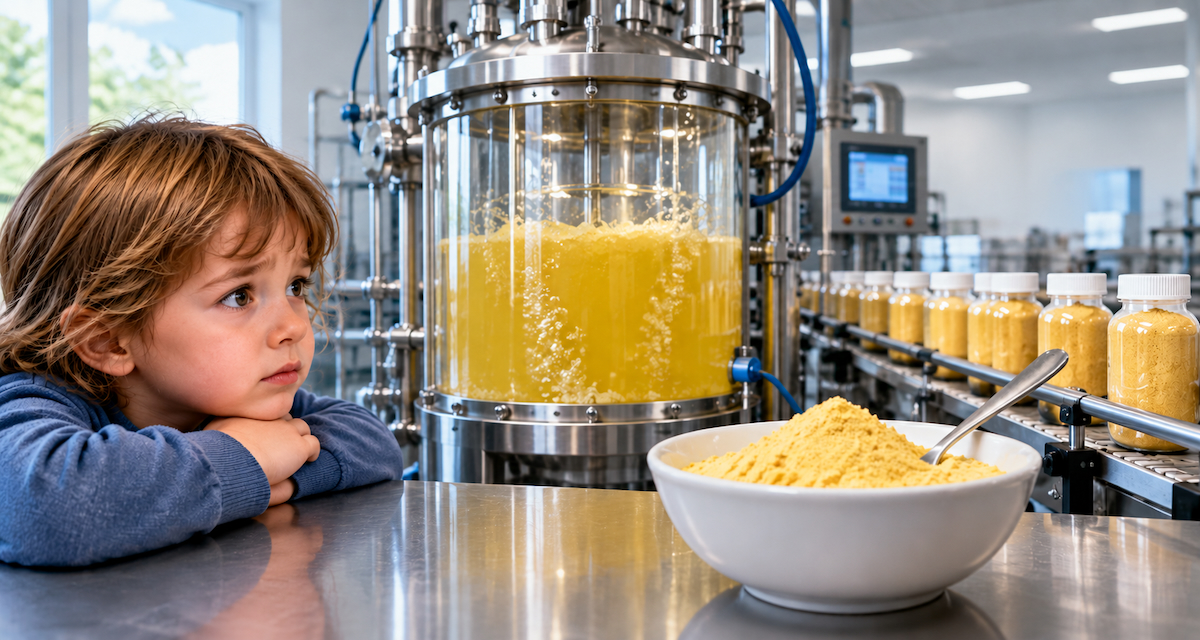
Humans have fermented foods for thousands of years: sauerkraut, yogurt, sourdough, kefir, kimchi, cheese, etc. But precision fermentation is different involving genetically engineering yeast, fungi, or bacteria so that the organism functions as a biological factory, producing a particular protein, enzyme, fat, vitamin, flavoring, or other substance (palatants). The organism is grown in a fermentation tank, the desired product is reportedly recovered and purified, and that ingredient then enters the food supply.
The word “precision” refers primarily to the intended genetic modification and desired product. It does not necessarily tell us the complete composition of what comes out at the other end of the process. That distinction became one of the central themes of our FDA presentation:
- How many genomic changes were made to the production organism?
- What else did that organism express or secrete?
- What metabolic byproducts were produced during fermentation?
- How completely were cells, DNA, host proteins, and other constituents removed during purification? Most importantly,
- What is actually present in the finished ingredient that people are eating?
In other words, precision of intent is not the same thing as the demonstrated purity of the outcome. Our presentation followed that question through the manufacturing process, from genetic engineering and fermentation to cell removal, purification, and the finished ingredient.
When Dr Fagan looked at the finished product
This is where the discussion moves from our theoretical concerns to documented and published laboratory findings. Dr. Fagan and his colleagues recently used multiple analytical techniques to examine a commercially available “synbio milk” containing recombinant bovine beta-lactoglobulin produced using genetically modified Trichoderma reesei, a fungus.
What they found: Shotgun proteomics detected 236 T. reesei proteins. Untargeted mass spectrometry identified 93 compounds in the synbio milk that could not be chemically identified by comparison with the large mass-spectral databases used by the investigators. Of 69 low-molecular-weight compounds identified in bovine milk, only about seven were detected in the synbio product, and those were present at substantially lower levels. Three independent analytical approaches also suggested that fungal proteins constituted a large proportion of the protein in the tested product.
Detecting 236 fungal proteins does not establish that those proteins cause disease, and finding 93 unidentified compounds does not prove that those compounds are toxic. But that is not the point. The study raises a regulatory question: if the finished product contains substantially more biological components than the intended protein, shouldn’t that finished product be thoroughly characterised before we conclude that it is safe for widespread and repeated consumption?
This is precisely where I believe the discussion belongs.
We should not claim harm where harm has not been demonstrated, but neither should an absence of demonstrated harm be substituted for evidence of safety.
GRAS: Is the old system adequate for a new technology?
Many precision-fermentation-derived ingredients enter the food supply through existing food/law pathways, including GRAS, or “Generally Recognized as Safe”. GRAS is not the same as the premarket approval process required for a new drug. Under federal food law, a substance intentionally added to food ordinarily requires food-additive approval unless its use is GRAS or falls under another exemption. Companies may reach GRAS conclusions without submitting a voluntary GRAS notice to FDA, which means the agency’s public inventory is not necessarily a complete accounting of all substances being marketed on the basis of GRAS conclusions.
This is important when an older regulatory structure is being used for a rapidly evolving biotechnology. The FDA has specific biotechnology guidance and consultation processes addressing genetically engineered and genome-edited plants. Precision-fermentation-derived food ingredients, however, are evaluated through existing food-law mechanisms rather than through a dedicated FDA regulatory framework specifically designed around precision fermentation.
This led us to a straightforward question for FDA: Where is the corresponding framework specifically addressing foods manufactured using genetically engineered microorganisms?
Change is afoot at the FDA around GRAS itself. In August 2026, the FDA proposed requiring notification for certain GRAS determinations, a change intended to provide the agency with more information about substances entering the food supply. But precision fermentation raises questions beyond notification alone. The issue is not simply whether FDA knows an ingredient exists. The issue is what testing should be required to characterise the finished product produced by an engineered biological system.
My question is yet again: What about the children?
This is where my perspective differs from that of a laboratory scientist or an agricultural researcher. I have spent more than forty years looking at children, and the children I care for today are not the children I cared for when I began practicing medicine. We now evaluate children against a background of enormous burdens of obesity, allergic and immune-mediated disease, neurodevelopmental disorders, gastrointestinal disease, and metabolic dysfunction. The kids are different. The landscape is not the same.
Let’s be clear. That observation does not establish that precision fermentation is causing these conditions. Precision-fermented foods are far too new, and our presentation distinguished the rise in childhood chronic disease from evidence of causation. But that is exactly why I believe the burden should be on testing before widespread pediatric exposure rather than waiting years to determine whether a problem has emerged. Remember, the Precautionary Principle…
WHY?
The pediatric intestinal microbiome is still developing. Microbial metabolites help create an intestinal barrier, aid in immune maturation, immune tolerance, and metabolic signalling. Human pediatric data examining chronic exposure to precision-fermentation-derived host proteins, metabolites, and other constituents do not exist. These are not minor data gaps. This is one of the central questions that should be addressed when novel “foods” are introduced and become a part of children’s everyday diets.
Test what we actually eat
Our proposal to the FDA was not particularly complicated. Instead of focusing on whether the intended protein was successfully produced, we focused on characterising the finished ingredient: using untargeted proteomics to look for unintended host-cell proteins; metabolomics to identify unexpected fermentation products; examining batch-to-batch consistency; measuring residual host cells, cell fragments, and DNA; and assessing allergenicity and immunogenicity under real-world exposure conditions. When these products are intended for children, the evaluation should also include developmental exposure and potential effects on the intestinal microbiome and gut barrier.
Summarised in our presentation is the following; characterise the finished product, investigate unintended constituents, assess biological effects relevant to real consumers, and establish safety before widespread pediatric exposure. This is not anti-science or anti-innovation. Better characterisation is science. Asking manufacturers to know what they have actually made before millions of people consume it should be part of responsible innovation.
Fermentation is not always what you think it is
There is another piece of this pie-conversation that deserves public attention: transparency. Consumers understand “fermentation” as a traditional and healthy food process. When they see a vitamin or protein described as fermentation-derived, most people are unlikely to imagine a genetically engineered microorganism functioning as a product from a yeasty vat.
Traditional fermentation and precision fermentation are not synonymous. Nor does the name of the final ingredient necessarily tell a consumer how it was manufactured. A label may identify vitamin C, a protein, an enzyme, or a flavor without explaining that a genetically engineered microorganism was involved in its production.
I have been writing about essentially the same problem in my recent work on insect-derived food ingredients. The technology changes, but the question keeps coming back to transparency. People cannot make an informed choice about something they cannot identify.
If a genetically engineered fungus manufactured a protein in my child’s food, I want to know. If a genetically engineered microorganism was used to manufacture a vitamin, I want to know that, too. I want to know what organism was used, what was changed, what remains in the finished ingredient, and what testing was performed. Parents do not need industry marketing. They need information.
That, to me, is informed consent.
Did our thirty minutes matter?
I don’t know yet. Perhaps something will come from the meeting, and perhaps it won’t. But let’s be clear. The FDA heard directly from three people looking at this issue through very different lenses. They heard from Howard about livestock, soil, feed, and agriculture. They heard from John, whose laboratory investigated what was actually present in a precision-fermented product. And they heard from a pediatrician asking why the youngest members of society should become the de facto post-market safety study for a technology moving rapidly into the food supply.
There is a beautiful symmetry to our little group: Howard brings the soil and the animals, John brings the laboratory, and I bring the children. Agriculture, science, and medicine. Although we come from different backgrounds, we keep arriving at the same questions:
- What did we actually make?
- What is in the finished product?
- Has it been adequately tested?
- Does the person buying it know how it was produced?
Whether the FDA acts is not something I can predict. What we can continue to do is educate, ask uncomfortable questions, insist upon better science, and put the evidence in front of the people responsible for making decisions.
After twenty-five years of looking at food, pesticides, GMOs, and children’s health, my basic position has become remarkably simple.
Tell us what is in our food and how it was made. Test the finished product rather than assuming that producing the intended substance establishes the safety of everything else that accompanies it. When children will be consuming a new food repeatedly, study the children and their unique biological systems and development before, not after, widespread exposure.
And give parents enough information to make their own informed choices.
Don’t despair. Repair.
Further information
1. Velamuri R, Yertha T, Fagan J. Multi-omics profiling finds synbio milk differs nutritionally from bovine milk and contains 93 uncharacterized fungal metabolites and 236 fungal proteins. Scientific Reports. 2026;16:16029.
2. Lerner A, Lieber AD, Nelson-Dooley C, Leu A, Perro M, Koch G, Benzvi C, Smith J. Genetically Modified Microorganisms: Risks and Regulatory Considerations for Human and Environmental Health. Microorganisms. 2026;14(2):467.
3. U.S. Food and Drug Administration. GRAS Notice Inventory. FDA GRAS Notice Inventory
4. Jin J, den Besten HMW, Rietjens IMCM, Widjaja-van den Ende F. Chemical and Microbiological Hazards Arising from New Plant-Based Foods, Including Precision Fermentation-Produced Food Ingredients. Annual Review of Food Science and Technology. 2025;16:171–194. DOI: 10.1146/annurev-food-111523-122059.
This article first appeared on Michelle Perro MD's Substack. It is republished on GMWatch with the kind permission of Dr Perro.